Warehouse Pick Stick: Essential Tool for Efficient Order Fulfillment and Safety

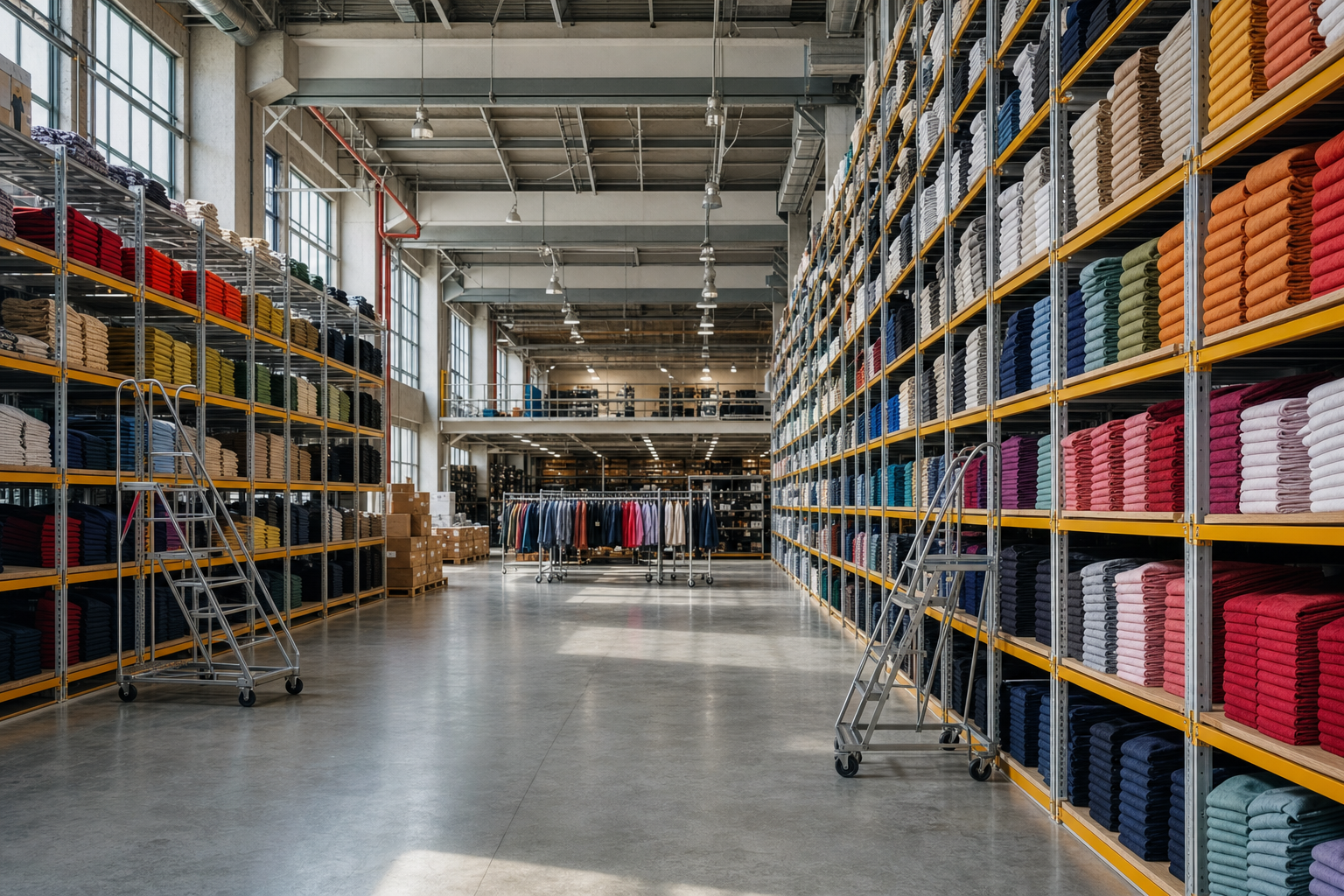
In a warehouse handling apparel fulfillment, the vertical cube above eye level is usually the most underused square footage on the floor. Brands store slower-moving SKUs there because nobody wants to reach for them repeatedly, but the consequence is that any pick from above the first two rack tiers takes twice as long as a floor-level pick once you account for setting up a ladder, climbing, retrieving the item, and returning to the pick path.
A warehouse pick stick changes that equation. It is an extendable pole tool, typically 4 to 12 feet when fully deployed, with interchangeable end attachments (hooks, suction cups, magnetic tips) that let a picker retrieve items from elevated positions without leaving the floor. The picker extends the tool to reach, engages the package, and brings it down without any ladder setup or equipment coordination.
That sounds simple. The reason it matters operationally is what it removes from the pick path: the interruption. Every time a picker has to stop, locate a ladder, position it, climb, retrieve, descend, and move the ladder before continuing, the pick list slows down. In a high-volume apparel warehouse handling hundreds of outbound orders per day, those interruptions compound across the shift in ways that are hard to see until you time them directly.
From the go-lives I have run this year, the pattern is consistent: warehouses that introduce pick sticks alongside a slotting review (moving slow-movers to high shelves and fast-movers to accessible positions) see noticeably smoother pick rates during peak periods. The tool only works as intended when the slotting logic is designed around it.
What Is a Warehouse Pick Stick and How Does It Work?
A warehouse pick stick is a telescoping pole with a locking mechanism that holds each extended section in place during use. The operator extends it to the required height, engages the end attachment with the package, and lowers the item in a controlled motion. Quick-release mechanisms on suction cup models let the worker detach the item without needing to reposition.
End attachments are the functional core of the tool, and the right choice depends on the packaging type being handled.
Rubber-coated hooks work for packages with handles or molded pick points. They are the most common attachment in general distribution environments because most corrugated cartons have top edges or handles the hook can engage. The limitation is irregular packaging with no consistent grip point.
Suction cups handle smooth-surfaced packaging: sealed plastic mailers, smooth-sided boxes, and shrink-wrapped containers common in apparel ecommerce fulfillment. Pneumatic suction cup models hold more reliably than manual-pressure versions, particularly for heavier packages at the outer edge of the weight range.
Magnetic tips are a niche attachment for metal containers or products with magnetic bases. Most apparel operations do not need them, but distribution centers handling mixed product categories sometimes carry all three attachment types.
The telescoping sections lock with an internal collar mechanism. A picker should confirm the lock before retrieving, not after extending. An unlocked section that collapses under the weight of a retrieved item is the most common cause of dropped product in high-shelf pick operations.
What Are the Real Safety Arguments for Pick Sticks?
Falls from ladders are one of the more expensive warehouse injury categories, both in human terms and in workers’ compensation cost. A pick stick does not address every fall risk in a warehouse, but it does eliminate the climb-to-retrieve scenario, which is one of the more frequent ladder-use cases in distribution environments.
The secondary safety case is cumulative strain. A picker spending six to eight hours on a pick list is performing hundreds of individual motions. The ergonomic position for a ladder-based high-shelf retrieve requires overhead extension, weight handling at height, and an awkward descent. Over a full shift, those motions accumulate into shoulder, back, and wrist strain that shows up in injury rates months later, not immediately after any single pick.
Pick sticks replace those overhead and ladder motions with a floor-level extension movement. The load is carried at or near hip height during retrieval, which is a more sustainable ergonomic position for sustained work. The difference matters most in warehouses with longer shifts or during peak seasons when overtime is common.
OSHA does not specify pick sticks in its warehouse standards, but the general duty clause (requiring employers to eliminate recognized hazards) creates an implicit case for any tool that removes a known injury mechanism. Operations managers who have documented ladder-related incidents have a concrete cost basis for the investment.
How Should Warehouses Decide Which Shelves to Stock at Height?
This decision matters more than the tool itself. A pick stick makes high-shelf retrieval practical, but it does not make it fast relative to floor-level picking. The time difference is smaller than ladder access, but it still exists.
The principle is pick frequency. SKUs that appear on outbound orders daily, or multiple times per shift, belong at mid-level or floor-accessible positions. Reaching for a fast-mover with a pick stick five times per hour is a slotting problem, not a tool problem.
High-shelf positions are suited for SKUs that move fewer than once per shift on average: carryover inventory between seasons, low-volume color variants, safety stock for slow-moving styles, and bulk pack items that only get pulled for large orders. Those items benefit from the vertical storage density without creating a meaningful time cost because the retrieval frequency is low.
In apparel warehouse operations, seasonal patterns make this more complex. A style that moves once per week in February may appear on every wholesale pick list in August. Slotting reviews before peak season should account for velocity changes, not just average annualized movement. A warehouse management system with pick frequency reporting makes that review practical. Without it, slotting tends to be set once and then drift, which is one way slower-moving items end up at eye level while fast-movers sit above the second shelf tier.
This connects to a broader execution problem at breakpoint 5 in the 6 Breakpoints framework: warehouse execution becomes less predictable when slotting and physical layout decisions fall behind the pace of the actual SKU velocity changes happening in the order management system. Pick sticks address one piece of that. The underlying data connection is what prevents the problem from recurring each season.
What Materials and Specifications Should You Look For?
Aluminum is the standard choice for high-frequency warehouse use. It is light enough that fatigue is not a concern across a full shift, and it handles standard warehouse inventory weights without flex or vibration at full extension. Steel offers more strength for heavier loads (25 to 30 pounds versus the typical 15-pound ceiling for aluminum models) but adds weight the picker carries for the full shift. Unless the operation regularly retrieves items above 15 pounds from height, the extra steel weight is rarely worth the trade-off.
Carbon fiber models offer the best weight-to-strength ratio but carry a premium price that is difficult to justify unless operator fatigue is a documented problem. The ergonomic case for carbon fiber is real in operations where pickers are using the tool continuously across an 8 to 10 hour shift, but for most distribution environments, aluminum is sufficient.
Handle design matters more than most buyers anticipate. A pick stick fully extended to 10 or 12 feet creates a lever effect on the grip. Handles that are undersized or lack cushioning cause hand fatigue much faster than the pole material or weight alone would suggest. Ergonomic grip designs with rubber or foam padding at the point of contact make a measurable difference in sustained usability.
Telescoping locking mechanisms should be tested before purchase. The internal collar design is more reliable than external clamp locks, which loosen under repeated use. A locking mechanism that develops play after a few weeks of daily use will produce an unstable pole at extension, which is a safety issue not a convenience issue.
The weight capacity specification on any model should be verified against the actual items being retrieved, not the general catalog description. Manufacturers test at rated load under controlled conditions; real warehouse use includes irregular package shapes, off-center weight distribution, and suction cup grip on slightly dusty surfaces. A 15-pound rated tool should not be used routinely for 14-pound items with no margin.
How Do Pick Sticks Fit Into a Broader Warehouse Operations Stack?
Pick sticks are floor-level tools with no direct system integration in their standard form. They execute picks faster, which improves the throughput metrics a WMS tracks, but the WMS does not know the tool exists. The benefit shows up as shorter pick times per order, which rolls into warehouse throughput and on-time shipment performance.
Some advanced models now embed barcode readers or RFID scanners in the handle, allowing the picker to confirm item identity at the moment of retrieval rather than in a separate scan step after bringing the item down. That integration reduces the chance of a misidentified pick reaching the pack station, which is one of the more common pick accuracy problems in high-bay storage. The scan confirmation happens in the pick motion rather than as an additional step.
For apparel fulfillment operations managing multiple channels (wholesale, DTC, and marketplace orders out of the same facility), pick accuracy at the item level matters more than in single-channel environments. A wholesale order shipped with the wrong colorway creates a chargeback risk on top of the operational cost of the return. Getting the confirmation step right at retrieval is worth the incremental scan time.
The broader warehouse execution picture, including slotting logic, pick path sequencing, and inventory location accuracy, is what determines whether a pick stick delivers its full potential or just adds one more tool that workers use inconsistently. The warehouse management module in Uphance handles pick list generation, inventory location tracking, and scan-based confirmation across the pick-pack-ship sequence. Pick sticks slot into that workflow at the retrieval step, where the WMS assigns the location and the tool handles the physical reach.
For a more complete view of where warehouse execution fits in the operational picture for apparel brands, the 6 Breakpoints assessment identifies which execution pressure points are creating the most drag on your specific operation.
Take the 6 Breakpoints assessment to identify your warehouse execution gaps.
Frequently asked questions
Where this fits in the Uphance platform
Ronnell writes about onboarding, adoption, and operational readiness for apparel brands moving to a connected platform. His articles focus on what it takes to go live with confidence and sustain strong execution across channels, warehouses, and teams. As Head of Customer Success and Onboarding at Uphance, he leads the implementation phases that turn a software signature into running operations. He writes about kickoff scoping, data migration, sandbox cutover, change management patterns, and the stakeholder alignment work that determines whether a connected platform actually changes how a brand runs, or just adds another login to the existing chaos.
Ruchit writes about product strategy for apparel operations, covering how mid-market fashion brands use connected workflows to manage product development, inventory, orders, warehouse execution, and reporting. As Head of Product at Uphance, he shapes the roadmap that ties PLM, PIM, BOM management, allocation, fulfillment, and warehouse operations into one system. His articles dig into apparel-specific operational mechanics: tech packs, spec sheets, putaway, pick-pack, landed cost, and the data plumbing that makes inventory truth possible across multiple channels and locations. He focuses on the workflow-level questions that separate generic ERPs from systems built for how apparel brands actually run.