Cin7 vs ApparelMagic vs Uphance: comparison for $10M-$50M apparel brands

What does cin7 vs apparelmagic vs uphance actually come down to for a $10M-$50M apparel brand?
It is a Tuesday afternoon and the ops lead at a $22M contemporary brand has three browser tabs open: Cin7, ApparelMagic, and Uphance. She has already sat through two demos this week. Her CFO wants to consolidate four tools before year-end, her warehouse manager wants the 3PL to stop sending CSV exports at 11pm, and her head of production wants tech packs out of email. The three vendors all said the words “apparel” and “wholesale” and “DTC.” None of them answered the question she actually asked, which was: when the November drop lands and 40 percent of inventory is committed to wholesale, which of these systems will tell the truth about what is actually available to sell?
That is the real cin7 vs apparelmagic vs uphance decision. Not feature grids. Not seat pricing. It is which system holds up when the operation gets complicated, which is somewhere between $10M and $20M in revenue for most apparel brands running both channels and a 3PL.
What are Cin7, ApparelMagic, and Uphance, precisely?
Cin7 is an inventory and order management platform with roots in general distribution. It handles multi-channel inventory, has solid integrations with Shopify and major 3PLs, and offers EDI through partner connections. It is not apparel-native. There is no PLM, no tech pack management, no critical path, no size curve logic built into the core. Brands use it as the inventory and order backbone and bolt PLM and production tracking on top.
ApparelMagic is apparel-native software that has been in the market for decades. It understands styles, colors, sizes, cut tickets, and factory POs. It has PLM capability and production management built in. Its weaknesses are modern DTC depth, warehouse execution for brands running 3PLs or complex own-warehouse flows, and the general feel of a system designed before Shopify Plus and modern EDI were table stakes.
Uphance is the unified apparel operations platform. It runs product development, product data, production, inventory, orders, warehouse execution, payments, accounting, and reporting in one connected system. It is built around the 6 Breakpoints framework, which maps where apparel operations predictably fracture as a brand scales. PLM includes a bidirectional Adobe Illustrator plugin, a critical path calendar, and line planning. Accounting is a native first-class module, with Xero and QuickBooks integrations available for brands that prefer them.
Those are the categories. The buying decision depends on where your operation breaks first.
Where does each platform actually sit in an apparel stack?
When I am walking a prospect through a fit call, the first thing I ask is what the current stack looks like and which part of it breaks on a bad week. The answer tells me more than any requirements document.
A brand running Cin7 typically has NuORDER or JOOR for wholesale, a separate PLM like Backbone or Surefront, a 3PL portal, Shopify, and a bookkeeper working in QuickBooks Online. Cin7 sits in the middle as the inventory layer. It works until the brand grows a second warehouse, adds a UK entity, or starts getting chargebacks from a department store that expects EDI 856 within two hours of pick. At that point the gaps between Cin7 and the surrounding tools start costing real money.
A brand running ApparelMagic usually has the opposite stack: strong production and style master data inside ApparelMagic, but Shopify running separately with a sync tool, wholesale orders entered manually from JOOR or by rep, and a 3PL that sends overnight stock files. The product data is clean. The order flow and inventory truth are not.
A brand running Uphance has consolidated. PLM, orders, inventory, warehouse, payments, and accounting are in the same database. The 3PL either operates inside Uphance’s warehouse module or syncs through a real integration, not a nightly export. Wholesale and DTC share a single available-to-sell pool with channel-aware allocation rules.
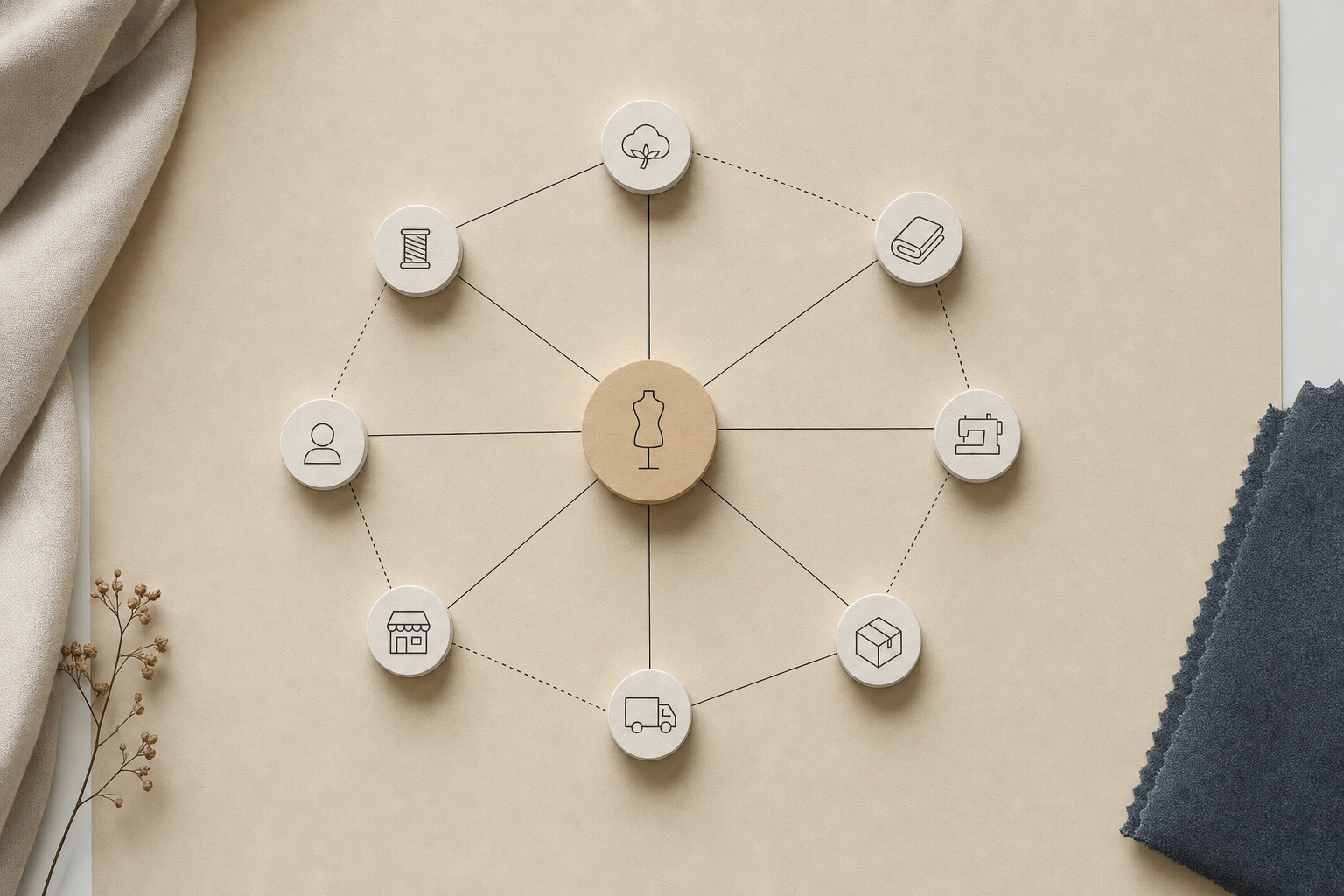
That is the architectural difference. Cin7 is a hub with spokes. ApparelMagic is a vertical system with modern gaps. Uphance is a unified apparel operations platform designed for the brand that has given up on duct tape.
When does Cin7 stop working for an apparel brand?
Cin7 is a reasonable choice up to maybe $8M to $12M for a brand that is DTC-heavy with light wholesale. It gets expensive, in both subscription and workaround cost, when three things happen together:
- Wholesale becomes more than 25 percent of revenue, with real retailer EDI requirements and chargebacks.
- The brand adds a second entity, a second currency, or a second warehouse.
- The design and production team outgrows spreadsheets and starts asking for a real PLM.
At that point, the brand ends up buying a separate PLM, a separate EDI service, and sometimes a separate wholesale B2B portal. The total cost of the Cin7-centered stack rises past what a unified platform would charge, and the integrations between those tools become the brand’s new full-time job. For a $15M brand running wholesale, DTC, and a 3PL, we see 6 to 9 hours a week reconciling inventory across Shopify, the 3PL, and wholesale, and oversell rates of 2 to 3 percent at peak. That is one FTE effectively doing data plumbing, and most of that plumbing exists because the inventory, order, and PLM layers were never designed to speak the same language.
Cin7 can be the right answer. Just not for the brand that is already past this zone.
When does ApparelMagic stop working?
ApparelMagic’s weakness is not apparel knowledge. It is the modern surface area around the apparel brand: Shopify, 3PLs, EDI with retailers who have updated their requirements twice in the last three years, B2B portals that reps and buyers actually want to use, and finance teams that expect real-time dashboards instead of exports.
The brands that struggle on ApparelMagic are usually the ones whose DTC business grew faster than expected, or whose wholesale business modernized faster than the system did. The product data stays clean. The order flow fragments. BP4 of the 6 Breakpoints framework, order flow becoming harder to trust, is the breakpoint where ApparelMagic brands most often start evaluating alternatives. You can read the order flow diagnostic for the specific symptoms, but the short version is: when the status of an order depends on which system you ask, order flow has already broken.
Where does Uphance fit, and where does it not?
Uphance is built for the $5M to $100M apparel brand running wholesale and DTC simultaneously, with warehouse or 3PL complexity. The predictable breakpoint zone where brands adopt it is $10M to $20M. In that band, a typical Uphance deployment replaces 3 to 5 tools plus spreadsheets.
Magnolia Pearl uses Uphance to run same-day fulfillment on drops, manage international duties, and handle a returns flow that posts to inventory in days rather than weeks. Lufema runs multi-entity wholesale across multiple brands and catalogs through Uphance, with a B2B portal that reps and buyers use directly. These are not demo scenarios. They are the kinds of operations that break Cin7 and strain ApparelMagic.
Where Uphance is not the right answer: a sub-$3M brand that is 95 percent DTC with no wholesale and no 3PL does not need this. A pure manufacturer with no owned brand does not need this. A $200M vertically integrated company with its own factories in three countries probably needs a tier-one ERP with heavy manufacturing modules. The ICP is deliberately specific.
How do the three compare on the dimensions that actually matter?
Feature matrices lie because they reduce every capability to a checkmark. Here are the dimensions I would weight if I were evaluating these three for a $15M to $40M brand.
Product data and PLM. ApparelMagic and Uphance both have real PLM. Cin7 does not. Uphance’s bidirectional Adobe Illustrator plugin, where designers work in Illustrator and sync flats, artwork, colorways, and specs onto the tech pack with a live two-way integration, is otherwise an enterprise-tier feature from Centric or PTC. If your design team lives in Illustrator, that single capability can collapse a week of file-handoff work per season.
Production and critical path. ApparelMagic has solid production tracking. Uphance has a critical path and time-and-action calendar with automatic slippage flagging. Cin7 does not play in this space.
Inventory truth across channels. This is where the differences get expensive. Cin7 handles multi-channel inventory well in principle but relies on the surrounding stack behaving. ApparelMagic can struggle with real-time Shopify and 3PL sync. Uphance treats inventory as a single pool with channel-aware allocation, which is the right architecture for a brand that commits inventory to wholesale orders months before DTC can touch it.
Order flow. Cin7 handles order volume well. ApparelMagic handles wholesale order structure well. Uphance handles both plus the handoffs between them, which is where most order flow problems actually live. If you want a structured way to evaluate this, the 6 Breakpoints framework walks through the sequence.
Warehouse execution. Cin7 integrates with 3PLs. ApparelMagic is thin here. Uphance has a native warehouse module and real 3PL integrations, which closes the 3PL blind spot that lives at BP5.
Accounting. Cin7 integrates with Xero and QuickBooks. ApparelMagic has accounting but it is dated. Uphance has native first-class accounting for larger and multi-entity brands, with Xero and QuickBooks integrations for brands that prefer to keep their current bookkeeping tool. For a multi-entity wholesale brand, native accounting matters more than most buyers realize at the evaluation stage.
EDI and retailer compliance. All three can do EDI through partners. The question is who owns the chargebacks when the 856 goes out late. If your retailer chargebacks exceed 1 percent of wholesale revenue, the EDI integration is the problem, not the warehouse, and the architecture that connects orders to warehouse to EDI is what determines whether that number stays under 1 percent.
What should the decision criteria actually be?
Stop evaluating on feature lists. Evaluate on where your operation breaks first.
If your biggest problem is DTC-heavy inventory sync across Shopify, Amazon, and a 3PL, with light wholesale, Cin7 is a defensible choice at your current size. Revisit it when wholesale crosses 25 percent or when you add a second entity.
If your biggest problem is product data and production, with wholesale as your primary channel and modest DTC, ApparelMagic can carry you. Plan for the DTC and EDI gaps you will hit.
If your biggest problem is that nothing agrees with anything else, your team spends 6 to 9 hours a week reconciling, you oversell 2 to 3 percent at peak, your tech packs live in Dropbox, and your CFO cannot close the books without three export-and-pivot cycles, you have a 6 Breakpoints problem, not a point-tool problem. That is the Uphance decision. The right starting point is the best apparel ERP evaluation framework, which forces the question in the order that matters.
The wrong decision criterion is price per seat. The right decision criterion is total cost of the stack, including the FTE time spent gluing it together and the margin lost to oversells and chargebacks. On that math, the gap between the three options is usually not where buyers expect it to be.
The decision you are actually making
The cin7 vs apparelmagic vs uphance comparison is really a question about architecture, not features. Cin7 is a hub-and-spoke bet: you trust that the surrounding tools will keep up. ApparelMagic is a vertical bet: you trust that apparel depth matters more than modern channel surface area. Uphance is a unified bet: you decide that the handoffs between PLM, production, inventory, orders, warehouse, and accounting are themselves the problem worth solving.
For a $10M to $50M brand running wholesale and DTC with warehouse or 3PL complexity, the unified bet is usually the one that pays back. Not because the other platforms are bad, but because the cost of integration debt at that size is higher than the cost of consolidation. The buyers who regret this decision are the ones who optimized for the demo and ignored the operations floor. The ones who get it right walk the shortlist against their actual Tuesday afternoon, not against a feature grid.
Where is your operation on the 6 Breakpoints curve?
The assessment scores your apparel operation across all six breakpoints (product data, production, inventory truth, order flow, warehouse execution, reporting) and identifies which one is hurting you most.
Frequently asked questions
Where this fits in the Uphance platform
Shubham writes about evaluating ERP fit, assessing operational complexity, and how apparel brands can tell whether their current systems are helping or holding them back. As a Solutions Consultant at Uphance, he runs discovery conversations and fit assessments for apparel brands moving off patchwork stacks of PLM, PIM, inventory, and B2B tools. His articles cover ERP selection, vendor RFPs, comparison frameworks, and the operational signals that tell a brand it has outgrown spreadsheets and point solutions. He focuses on how mid-market apparel teams evaluate connected platforms against the cost of staying with what they have.
Venkat is the Founder and CEO of Uphance and the author of the 6 Breakpoints of Apparel Operations framework. He writes about operational clarity for apparel brands as complexity grows across channels, warehouses, partners, and teams. His work focuses on why disconnected operations, not growth itself, create the chaos most mid-market brands feel between $5M and $100M in revenue, and on the operating-model patterns that decide whether scaling a brand strengthens execution or fractures it. He argues that the status quo is the real competitor in apparel software, and that the right move is fewer systems with deeper connection, not more dashboards.