Unleashed alternatives for apparel brands in 2026

Why are apparel brands searching for unleashed alternatives in 2026?
A controller at a $14M contemporary brand sent me a screenshot last month. Three browser tabs open: Unleashed showing 412 units of a core tee in black/medium, Shopify showing 380, the 3PL portal showing 357. The wholesale ops lead had just promised 300 units to a Nordstrom PO shipping Friday. Nobody in the room could say, with evidence, which number was right. The finance team had been reconciling the three systems manually every Monday for eleven months. That call is the reason this search query exists. Buyers typing unleashed alternatives apparel into Google in 2026 are not shopping for features. They are shopping for a way to stop that Monday meeting.
Unleashed is a solid piece of software. It was built for inventory and light manufacturing across a broad set of industries, which is both its strength (clean inventory primitives, reasonable BOM handling, decent reporting) and its structural limit for apparel. Apparel breaks generic inventory tools in specific, predictable places: the size/color matrix, the wholesale EDI stack, the drop calendar, the 3PL ASN loop, and the way returns move through grading before they post back to available-to-sell. None of those are Unleashed’s fault. They are simply not what it was designed to do.
What does an apparel brand actually need from an inventory and operations system?
Before comparing alternatives, it helps to define the job. An apparel operations platform at the $5M to $100M band needs to hold a single, trustworthy inventory position across DTC, wholesale, marketplace, and 3PL locations, and it needs to allocate that position against channel-specific commitments. That is BP3 of the 6 Breakpoints framework, the point at which inventory truth gets weaker and every downstream decision inherits the error. If the number in the system is wrong, the OTB is wrong, the allocation is wrong, the ship confirmation is wrong, and the chargeback is coming.
The job also includes product data (styles, colorways, size runs, seasons, tech packs), production (POs to cut-and-sew factories, WIP visibility, landed cost), order flow (DTC, wholesale with price lists and payment terms, EDI 850/855/856/810), warehouse execution (pick, pack, ASN compliance, routing guides), and reporting that a merchandiser can act on. Unleashed does the inventory and production pieces competently. It does not do the apparel-specific wholesale, EDI, or drop allocation pieces, which is why the stack around it tends to grow: a separate B2B portal, a separate EDI service, a separate PLM, a separate 3PL integration layer, and a spreadsheet to hold them together.
From the vendor evaluations I sit on each week, the pattern is boringly consistent. A brand picks Unleashed at $4M because it is clean, affordable, and better than QuickBooks for inventory. Somewhere between $10M and $20M, usually when wholesale crosses 40 percent of revenue or the brand lights up a 3PL, the stack starts leaking. By $18M there are three to five bolt-ons, one FTE doing nothing but reconciling across them, and 6 to 9 hours a week going into Monday’s inventory meeting. That is the moment the search for alternatives starts.
Where does Unleashed stop fitting an apparel operation?
Five places, in the order they usually show up.
Size and color matrix handling. Unleashed treats each SKU as a discrete item. A style with 6 colors and 7 sizes is 42 SKUs, created and maintained one at a time or through CSV import. Apparel-native systems treat the style as the parent object and the matrix as a view, which matters when you are launching 80 styles a season and the merchandiser needs to see sell-through by color across sizes, not by SKU.
Wholesale and EDI. Unleashed has sales orders, price lists, and customer records. It does not natively speak EDI 850, 855, 856, 810, or 846. For a brand shipping to majors (Nordstrom, Bloomingdale’s, Saks, Zappos, Revolve on EDI), that gap is filled by SPS Commerce or a similar VAN, which sits between Unleashed and the retailer and requires its own mapping, testing, and chargeback-dispute workflow. Every mismatch between what Unleashed thinks is on the ASN and what the retailer actually receives becomes a compliance chargeback. If your chargebacks exceed 1 percent of wholesale revenue, the integration is the problem, not the warehouse.
Drop-based allocation. DTC apparel increasingly runs on drops: Thursday 10 AM, limited quantities, allocated against pre-sold wholesale commitments and VIP holds. Unleashed can hold inventory in locations, but it does not have channel-aware available-to-sell logic that respects wholesale-committed pools, buyer holds, and 3PL in-transit as first-class concepts. The workaround is manual: freeze a quantity in a sub-location, update Shopify, hope nobody oversells.
PLM and tech packs. Unleashed has BOMs. It does not have tech packs with construction notes, graded specs, trim libraries, lab dips, fit sessions, or a time-and-action calendar that flags slippage from design to delivery. Brands using Unleashed almost always have a separate PLM (Backbone, Techpacker) or a Google Drive full of PDFs. The handoff from PLM to production in Unleashed is manual re-entry.
3PL reconciliation. The reason that controller had three tabs open. Unleashed can integrate with a 3PL via API, but the reconciliation between what Unleashed thinks is on hand, what Shopify is selling against, and what the 3PL actually has on the shelf is a daily operational task. At $15M with wholesale plus DTC plus a 3PL, that reconciliation is 6 to 9 hours a week and the oversell rate runs 2 to 3 percent at peak. Those are the back-of-envelope numbers I use on fit calls, and they land every time because the controller has already lived them.
What are the real unleashed alternatives apparel operators evaluate?
The market splits into four buckets. Buyers typing the query usually think they are picking between products. They are actually picking between architectures.
Bucket 1: Other generic inventory and light-ERP tools. Cin7, DEAR (now Cin7 Core), Katana, Fishbowl, Zoho Inventory. These are peers of Unleashed. They share the same structural limits for apparel: SKU-first data model, no native EDI, no apparel PLM, no drop allocation logic. Switching sideways rarely solves the problem. It usually just resets the implementation clock.
Bucket 2: Generic mid-market ERPs. NetSuite, Microsoft Dynamics Business Central, Acumatica, often with an apparel vertical add-on (ApparelMagic on NetSuite, DMSi, etc.). These can be configured to handle apparel, but the implementation runs $150K to $500K and 9 to 18 months, and the apparel-specific logic lives in a third-party extension that may or may not keep pace with the base platform. For a $15M brand, the cost and timeline are out of proportion to the problem.
Bucket 3: Legacy apparel ERPs. AIMS 360, RLM, BlueCherry, Exenta. These were built for apparel, which is their strength, and most of them were built 15 to 25 years ago, which is their limit. The data models are correct. The user experience, API surface, and integration posture are often not. Brands that have been on AIMS for a decade know exactly what I mean.
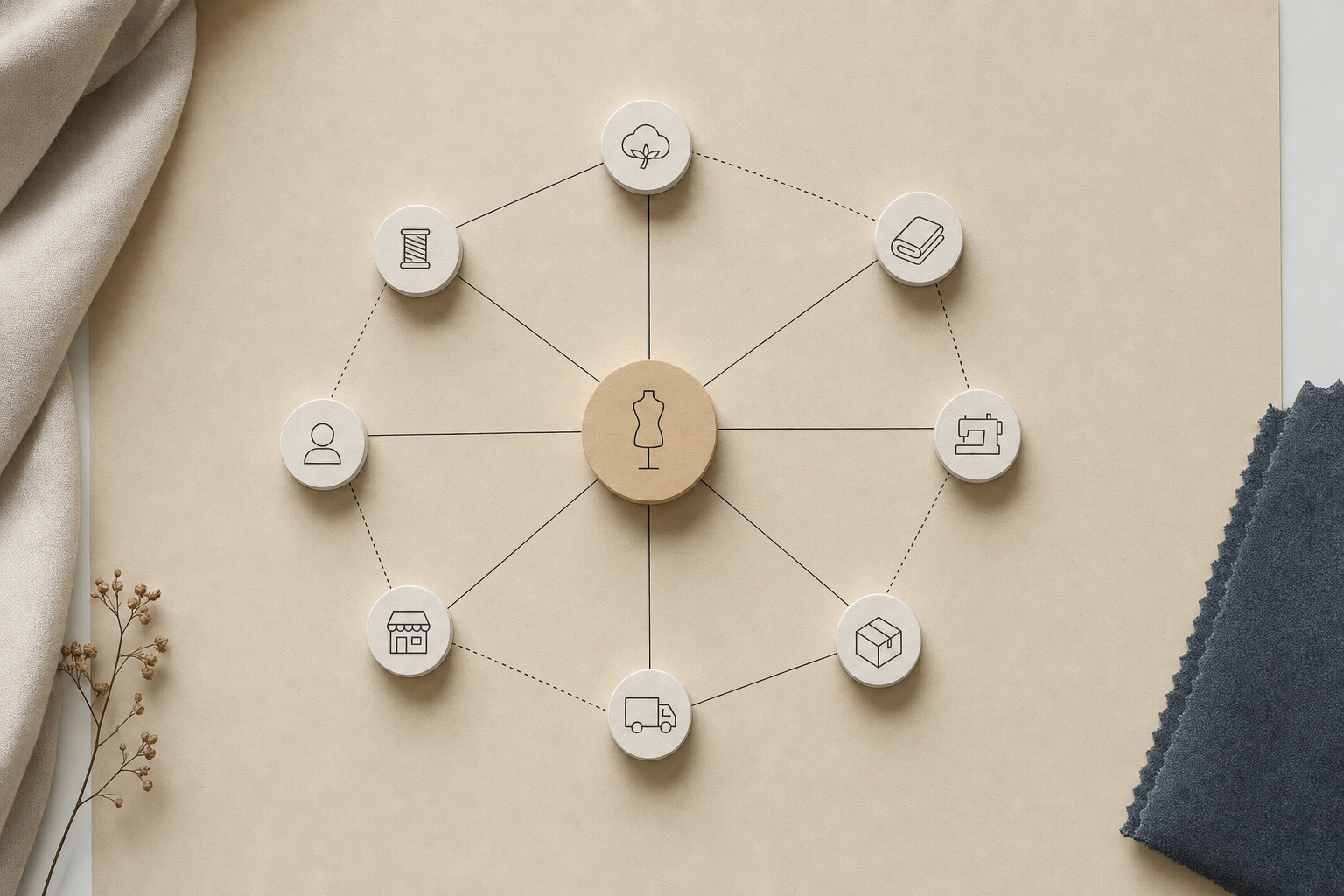
Bucket 4: Modern apparel operations platforms. This is the bucket Uphance sits in, alongside a short list of other apparel-native platforms. The thesis is that a brand running wholesale and DTC with a 3PL at $5M to $100M needs product data, production, inventory, orders, warehouse, payments, accounting, and reporting in one connected system, with apparel-specific logic native rather than bolted on. The best apparel ERP evaluation comes down to whether that single system actually closes the reconciliation gap, or whether it just moves it.
How do you decide between the buckets?
Three questions, in order.
One: how much of your revenue runs through wholesale with EDI retailers? If it is under 10 percent, you can probably live with Unleashed plus Shopify plus a lightweight B2B tool for another revenue tier. If it is over 25 percent and growing, EDI, routing guide compliance, and chargeback management are structural, not optional. You need a system where the wholesale order, the pick, the ASN, and the invoice are the same object, not four objects reconciled nightly.
Two: do you run a 3PL, or are you planning to in the next 18 months? The 3PL is where BP5 (warehouse execution) and BP3 (inventory truth) collide. If the 3PL is a black box between your system and your customers, you will build the reconciliation workflow by hand, in a spreadsheet, by Thursday of your first peak week. The inventory truth scorecard is a decent way to pressure-test how exposed you actually are before you shop.
Three: how fast do you drop new product? If you run two seasons a year with a 6-month lead time, a legacy ERP or a generic tool with discipline can hold. If you run 10 to 20 drops a year with pre-orders, waitlists, and allocated wholesale, you need a system where styles, colorways, drops, and channel-specific ATS are first-class concepts, not notes in a shared sheet.
What does the migration from Unleashed actually look like?
Less scary than the ERP horror stories, more involved than a Shopify theme swap. The honest version:
- Clean the data in Unleashed first. Deduplicate styles, retire dead SKUs, fix the size runs that got entered three different ways. Every system you move to will inherit whatever you bring. Two weeks of data hygiene saves two months of post-launch confusion.
- Map styles, colorways, and size runs to the new system’s parent/child model. This is where SKU-first data breaks and style-first data earns its keep. A good implementation partner does this with you, not for you.
- Rebuild the integrations in parallel: Shopify, 3PL, EDI VAN, payment processor, accounting. Run both systems for one full cycle (usually one month) before cutting over. The dual-run month is where you catch the edge cases.
- Cut over at the start of a season, not the middle. Nobody wants to migrate during market week.
Most $10M to $20M brands land in 8 to 14 weeks from kickoff to cutover if the scope is apparel operations and not a full accounting rebuild. If accounting is in scope, add 4 to 8 weeks.
What usually goes wrong in the Unleashed replacement decision?
Three failure modes I see repeatedly on evaluation calls.
The first is buying another generic inventory tool because the demo looked cleaner. Two years later the same reconciliation meeting is happening on a different interface. The structural problem (SKU-first data model, no native wholesale, no EDI) did not change.
The second is over-buying into NetSuite because a board member suggested it. The $15M brand ends up with a $300K implementation, 14 months of change management, and a system that still needs an apparel extension to do what an apparel-native platform does out of the box. The brand is now paying for ERP complexity it will not use for five years.
The third is doing nothing. The reconciliation meeting continues. The FTE doing data plumbing stays doing data plumbing. The 2 to 3 percent oversell rate at peak gets absorbed as a cost of doing business, which it is not. It is a cost of the architecture.
The real cost of the status quo, which is Uphance’s actual competitor more often than any named vendor, is not the software bill. It is the hours, the chargebacks, the oversells, the delayed market decisions because the data is not trusted, and the headcount hired to paper over the gap. Apparel ERP that holds inventory truth across wholesale, DTC, and 3PL in one object is the architectural answer. Which specific vendor delivers it is the shopping question.
The decision underneath the search
Most brands typing unleashed alternatives apparel into a search bar are not actually asking which product is best. They are asking whether the pain they are in is normal, whether anyone else has solved it, and whether the fix is a tool swap or a structural change. The answer is usually structural. Swapping Unleashed for another generic inventory tool buys six months of novelty and inherits the same gaps. The fix is moving to a system where the apparel-specific objects (style, colorway, size run, drop, wholesale PO, ASN, chargeback, 3PL location) are native, not simulated through SKUs and sub-locations and shared spreadsheets.
If you are in the $10M to $20M breakpoint zone, the question to put to any vendor on your shortlist is simple. Show me, in your demo environment, how a wholesale PO for 300 units allocates against DTC available-to-sell, flows to the 3PL as a pick, generates an ASN to Nordstrom, and posts the invoice to accounting, without me touching a spreadsheet. Whoever can show that in one system, with one data model, is on the shortlist. Whoever cannot, including Unleashed, is a bolt-on waiting to become next year’s search query.
How accurate is your inventory really?
Nine questions estimate where your operation sits on the inventory-truth curve and how much revenue is at risk. Takes about three minutes.
Frequently asked questions
Where this fits in the Uphance platform
Shubham writes about evaluating ERP fit, assessing operational complexity, and how apparel brands can tell whether their current systems are helping or holding them back. As a Solutions Consultant at Uphance, he runs discovery conversations and fit assessments for apparel brands moving off patchwork stacks of PLM, PIM, inventory, and B2B tools. His articles cover ERP selection, vendor RFPs, comparison frameworks, and the operational signals that tell a brand it has outgrown spreadsheets and point solutions. He focuses on how mid-market apparel teams evaluate connected platforms against the cost of staying with what they have.
Venkat is the Founder and CEO of Uphance and the author of the 6 Breakpoints of Apparel Operations framework. He writes about operational clarity for apparel brands as complexity grows across channels, warehouses, partners, and teams. His work focuses on why disconnected operations, not growth itself, create the chaos most mid-market brands feel between $5M and $100M in revenue, and on the operating-model patterns that decide whether scaling a brand strengthens execution or fractures it. He argues that the status quo is the real competitor in apparel software, and that the right move is fewer systems with deeper connection, not more dashboards.