Tariff Proofing Your Fashion Business: A Complete Guide

With the global tariff war raging across nations in Asia and North America, it's quite natural to wonder if there's a chance your fashion business might be caught in the crossfire. Truth is, it can - unless you put in the effort to tariff-proof your business.
Failure to do this can lead to your profit margins eroding away in taxes.
In this guide, we'll walk you through how you can tariff-proof your fashion business, ensuring that your brand remains resilient and profitable.
Understanding Tariffs and Their Impact on Fashion Businesses
What are tariffs? Tariffs are taxes imposed by governments on imported goods. These can be in the form of:
Ad Valorem Tariffs: A percentage of the product’s value.
Specific Tariffs: A fixed fee per unit of imported goods.
Compound Tariffs: A combination of ad valorem and specific tariffs.
How Tariffs Affect Fashion Businesses
Tariffs can increase the cost of raw materials, fabrics, finished garments, and accessories. This can lead to:
-
Higher product costs due to added import taxes.
-
Reduced profit margins, affecting the brand's financial health.
-
Disrupted supply chains as suppliers may change prices.
-
Uncertainty in pricing strategies and customer communication.
-
Potential loss of market competitiveness.
Identifying Tariff Risks in Your Fashion Business
Analyzing Your Supply Chain
Start by mapping out your supply chain, identifying which of your suppliers are located in countries prone to high tariffs. Consider the following:
Raw materials and their country of origin.
Finished goods and their import tariffs.
Understanding HS Codes (Harmonized System Codes) for your products.
Monitoring countries with frequent trade disputes.
Understanding Trade Agreements
Stay updated on trade agreements affecting your business, such as:
Free Trade Agreements (FTAs) and their benefits.
Regional Comprehensive Economic Partnership (RCEP).
USMCA (United States-Mexico-Canada Agreement).
How to leverage Generalized System of Preferences (GSP).
Strategies for Tariff-Proofing Your Fashion Business
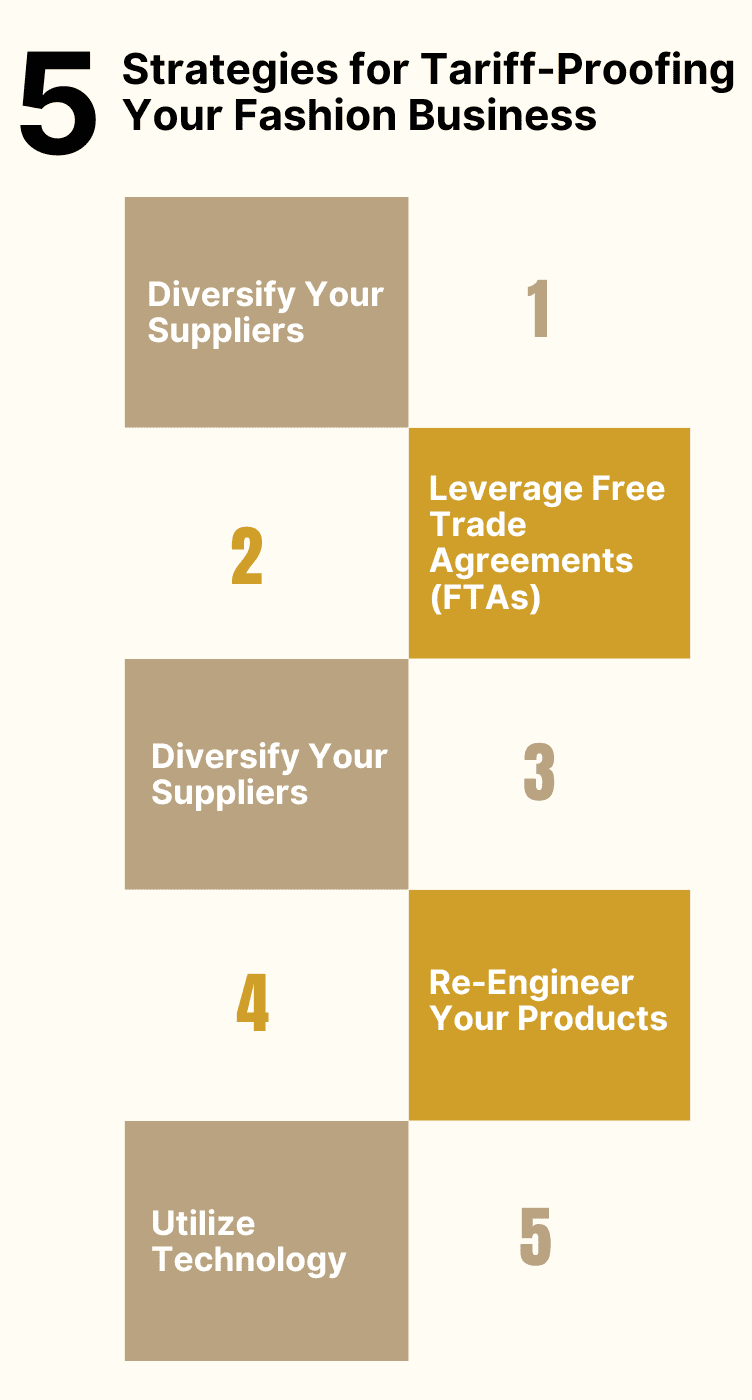
Tariffs are an inevitable aspect of international trade, but they don’t have to be a financial burden for your fashion business.
Although tariffs are inevitable and there's not much you can do about changing cross-border trading regulations, you can still tariff-proof your business. Doing so ensures that you remain competitive in a challenging global market.
Here are some fool-proof strategies you should try.
1. Diversify Your Suppliers
Don’t put all your eggs in one basket. Diversify your suppliers to reduce reliance on tariff-heavy regions. Here's how to do it:
Work with suppliers from countries with low or zero tariff rates.
Maintain a list of alternative suppliers for each product.
2. Leverage Free Trade Agreements (FTAs)
Identify and utilize FTAs applicable to your products. This can significantly reduce tariff costs.
Research applicable FTAs for your region.
Work with a trade expert to ensure compliance.
3. Optimize Your Supply Chain Logistics
Consolidate shipments to minimize customs costs.
Choose shipping methods that minimize your tariff exposure.
Use bonded warehouses for temporary storage without paying tariffs.
4. Re-Engineer Your Products
Re-design your products to use materials that have lower or zero tariffs.
Explore alternatives like recycled materials that may have lower tariffs.
Design modular products that can be assembled in tariff-free regions.
5. Utilize Technology
Leverage technology to monitor and forecast tariff changes.
Use tariff management software to automate tariff calculation.
Implement a digital dashboard for real-time tracking.
Conclusion
Tariffs are a reality in today’s global trade landscape, but they don’t have to threaten your fashion business. By understanding your risks and implementing the right strategies, you can protect your profits and keep your brand competitive.
Frequently asked questions
Where this fits in the Uphance platform
Venkat is the Founder and CEO of Uphance and the author of the 6 Breakpoints of Apparel Operations framework. He writes about operational clarity for apparel brands as complexity grows across channels, warehouses, partners, and teams. His work focuses on why disconnected operations, not growth itself, create the chaos most mid-market brands feel between $5M and $100M in revenue, and on the operating-model patterns that decide whether scaling a brand strengthens execution or fractures it. He argues that the status quo is the real competitor in apparel software, and that the right move is fewer systems with deeper connection, not more dashboards.
Ruchit writes about product strategy for apparel operations, covering how mid-market fashion brands use connected workflows to manage product development, inventory, orders, warehouse execution, and reporting. As Head of Product at Uphance, he shapes the roadmap that ties PLM, PIM, BOM management, allocation, fulfillment, and warehouse operations into one system. His articles dig into apparel-specific operational mechanics: tech packs, spec sheets, putaway, pick-pack, landed cost, and the data plumbing that makes inventory truth possible across multiple channels and locations. He focuses on the workflow-level questions that separate generic ERPs from systems built for how apparel brands actually run.