The Second-Warehouse Tax: What a Second Location Really Adds to Apparel Ops
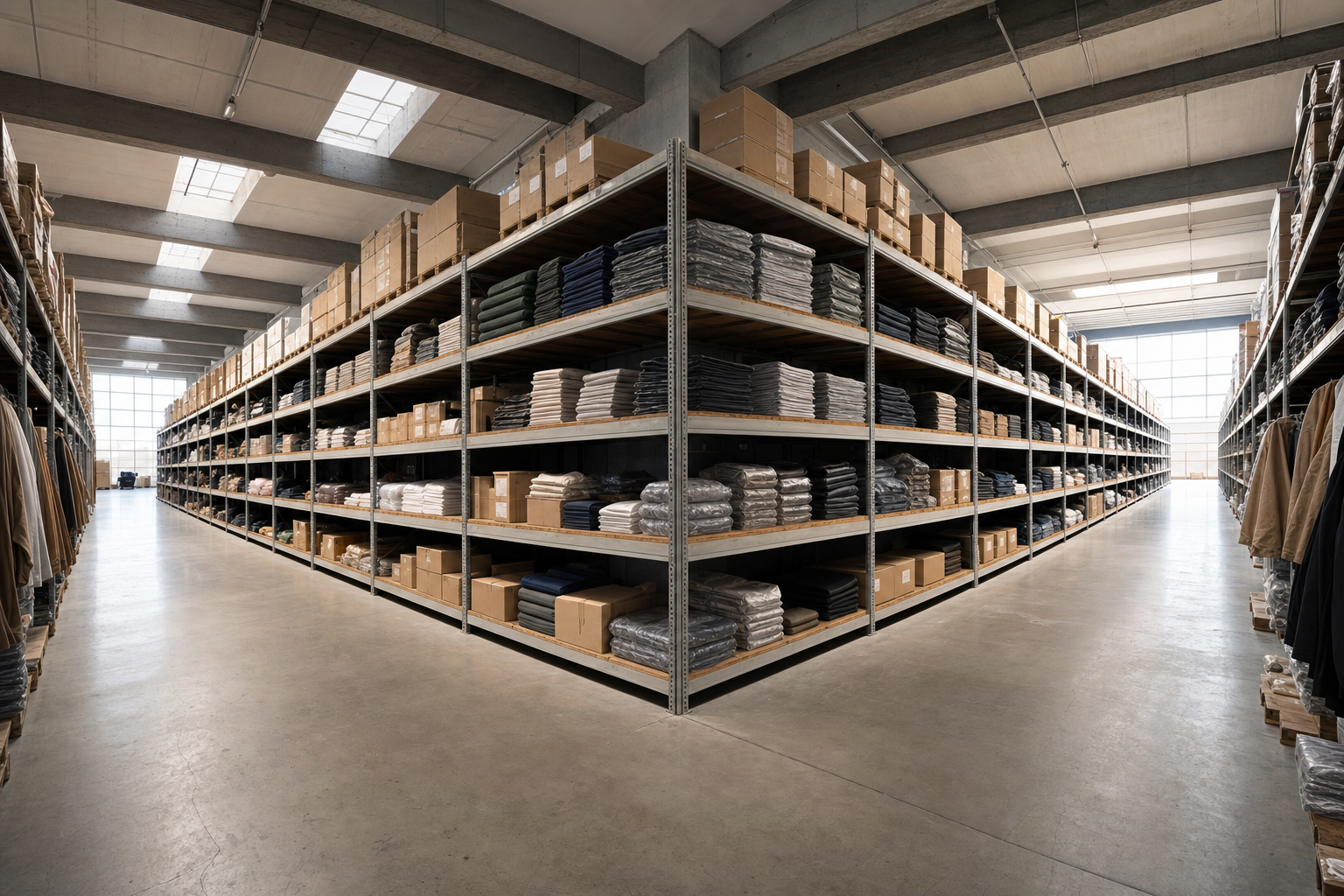
A $22M womenswear brand I worked through a fit call last month had just signed a lease on a second warehouse on the East Coast. The primary 3PL was in Nevada, the new one would be in New Jersey, and the operations lead walked me through the plan on a shared screen. DTC orders would route by zip code. Wholesale would stay in Nevada because that is where the EDI integration lived. Returns would go back to whichever location was closer to the customer. Transfers would happen weekly. It sounded clean on the call. By the time the second node was live for ninety days, their oversell rate at peak had roughly doubled, their warehouse team was emailing inventory snapshots back and forth to reconcile, and their CFO could not get a clean inventory valuation for the board pack.
What is the real cost of second warehouse apparel operations?
The cost of second warehouse apparel operations is the sum of three things, and only one of them shows up on a budget line. There is the obvious cost: lease, labor, 3PL per-unit fees, integration setup. There is the freight cost: moving inventory between nodes, paying expedited shipping when the wrong node has the unit. And there is the coordination tax: the hours your team spends reconciling what each node says it has, the oversells that happen when allocation logic was not rebuilt, the chargebacks that come from wholesale orders shipping short because DTC drained the pool, and the reporting drift that makes board numbers untrustworthy for a quarter.
The first cost is forecastable. Your 3PL gives you a rate card. The second cost is annoying but bounded. The third cost is the one nobody sizes correctly, and it is usually two to three times what the operations team budgeted for, because it is not really a warehouse problem. It is a systems problem that the second warehouse made impossible to ignore.
Why does a second node break what a single node hid?
With one warehouse, your inventory truth can be wrong and you will still ship most orders correctly, because there is only one pool to draw from. The errors hide. ATS in your ecommerce platform might be off by 40 units, but as long as the warehouse has the goods, the order ships. Wholesale allocations might double-count against DTC, but the picker grabs what is on the shelf and you reconcile after the fact.
With two warehouses, every wrong number becomes a routing decision. If your system thinks node A has 60 units and node B has 20, and the truth is reversed, you will route a wholesale ASN commitment to the wrong node, miss the ship window, and eat a chargeback. The errors stop hiding and start costing money on every order. This is exactly where Breakpoint 5 lives in the 6 Breakpoints framework: warehouse execution gets less predictable, and the 3PL blind spot turns from a reporting nuisance into an order-flow problem.
Across the vendor comparisons I have run this quarter, the pattern is consistent. Brands evaluating a second warehouse are almost never evaluating warehouse software. They are evaluating whether their current operational stack can survive the multiplication of every existing weakness by two. The vendor demo they think they need is a WMS demo. The demo they actually need is an allocation and inventory-truth demo.
How much coordination tax should you actually budget?
Here is a back-of-envelope frame I walk buyers through. A $15M brand running wholesale, DTC, and a single 3PL typically spends six to nine hours a week reconciling inventory across Shopify, the 3PL portal, and wholesale orders. Oversell at peak runs two to three percent. One FTE is effectively doing data plumbing across systems, even if that is not their job title.
Add a second warehouse without rebuilding the inventory architecture and those numbers do not stay flat. Reconciliation hours roughly double because there are now two 3PL portals to cross-check, plus a transfer ledger that needs to balance. Oversell at peak climbs because ATS calculations were built for a single pool. The data-plumbing FTE either becomes 1.5 FTE or that person quietly burns out and quits in month nine. None of this shows up in the warehouse business case the COO presented to the board.
The useful question is not “what does the second warehouse cost.” The useful question is “what does the coordination tax cost, and what would it cost to eliminate it before we go live.” If you are spending fifteen hours a week reconciling across two nodes and two channels at $15M, that is roughly $40,000 to $60,000 a year in fully loaded labor doing work that should not exist. At $30M with two nodes, it is closer to a full FTE that you will not get back even if you grow into it.
What decisions does a second warehouse force you to make explicitly?
This is the part most operations leads underestimate. Going from one node to two does not just add a location. It forces a series of architectural decisions that you were getting away with avoiding.
The first decision is channel ownership per node. Does wholesale ship exclusively from node A, or does it draw from whichever node is closer to the retailer DC? If it draws from both, your EDI 856 ASN logic has to know which node committed the units, because the carton labels and the ASN have to match what physically ships. Most mid-market brands do not have allocation logic this granular, and the workaround is to lock wholesale to one node, which then makes the freight cost worse.
The second decision is ATS calculation per node and per channel. A single global ATS number stops being meaningful the moment you have two nodes. You need ATS by SKU by node, and then you need a channel-aware view that subtracts wholesale-committed pools from what DTC can sell against. If your storefront keeps showing global ATS, you will oversell on DTC every time a large wholesale PO lands.
The third decision is transfer accounting. When you move 200 units of a SKU from node A to node B, where does it live during transit? Most spreadsheet-based brands either double-count it (both nodes show inventory) or lose it entirely (neither node shows inventory) for the three to five days it is on a truck. Both are wrong. You need an in-transit bucket that ATS respects but warehouses do not pick from, and you need transfer documentation that finance can value correctly at month end.
The fourth decision is returns routing. Returns should post to inventory in days, not weeks, and with two nodes you now have to decide whether returned units re-enter at the closest warehouse or get consolidated back to a primary location. The wrong decision here strands inventory at the secondary node where it does not match demand patterns, and your weeks-of-cover numbers start lying to you.
The fifth decision is reporting consolidation. Your inventory valuation, your weeks of cover by SKU, your sell-through reporting, all of it now needs to roll up cleanly across two nodes. If finance is exporting CSVs from two 3PL portals and stitching them in Excel, you have rebuilt the reporting reactivity problem that Breakpoint 6 describes, and the board pack becomes a political document instead of an operational one.
When should an apparel brand actually open a second warehouse?
In a vendor conversation with a buyer, the question I push back on most often is timing. A second warehouse is usually proposed for one of four reasons: shipping cost to East Coast customers is too high, wholesale retailers are demanding faster ship windows, a specific customer (often a major retailer with a regional DC) is driving the geography, or the primary warehouse is running out of physical space.
Only the fourth reason is unambiguously a warehouse decision. The first three are channel-economics decisions that look like warehouse decisions. Before you sign the lease, the honest version of the math is: what is the freight savings or ship-window improvement worth per year, and is it larger than the coordination tax of running two nodes for the next 24 months. For most brands in the $10M to $30M range, the answer is no. The freight savings are real but smaller than the operational drag, and the better move is to consolidate operational truth first and revisit the second node when revenue or a specific retailer commitment forces it.
There is one exception worth naming. Brands with a heavy international duty exposure on returns, like Magnolia Pearl handling cross-border DTC, often benefit from a regional node not for freight reasons but for returns-handling and duty-drawback reasons. That is a real reason, but it is a returns-architecture decision, not a fulfillment-speed decision, and it changes which questions you ask the 3PL during diligence.
What does a second warehouse expose about your inventory architecture?
A second warehouse is a stress test for inventory truth. If your current setup relies on Shopify as the source of truth for DTC, the 3PL portal as the source of truth for physical counts, and a spreadsheet as the source of truth for wholesale commitments, that arrangement was already lying to you at one node. At two nodes it stops being recoverable.
The architecture that actually holds up is a single inventory system that owns the per-node, per-SKU, per-channel allocation, with the 3PLs feeding it physical counts (not the other way around) and the storefront and B2B portal reading channel-aware ATS from it. This is the same pattern Lufema runs for multi-entity wholesale across multiple brand catalogs: one inventory backbone, multiple physical and channel surfaces reading from it. Without that backbone, the second warehouse is not a fulfillment upgrade. It is a multiplier on every existing weakness.
This is also why I push buyers to treat the second warehouse decision as a system decision, not a logistics decision. The 3PL contract is the easy part. The allocation logic, the channel-aware ATS, the transfer ledger, and the returns routing are the parts that determine whether the second node pays for itself or quietly costs you a full FTE and 200 basis points of margin for the next two years.
What to audit before you sign the second-warehouse lease
If you are within six months of opening a second warehouse, the most useful work you can do right now is not 3PL diligence. It is auditing your current inventory truth at one node. Run the inventory truth scorecard. Measure your reconciliation hours per week, your oversell rate at peak, and the number of systems your team checks before committing to a wholesale ship window. Those numbers are your baseline.
Then ask the harder question: which of the five architectural decisions (channel ownership, per-node ATS, transfers, returns routing, reporting consolidation) does your current stack handle natively, and which ones are handled by a person and a spreadsheet. Every spreadsheet answer is a future cost at two nodes. The brands that open a second warehouse and do not regret it spent the prior quarter consolidating those decisions into one system. The brands that regret it signed the lease first and tried to fix the architecture later, usually during peak.
The second warehouse is not the problem and not the upgrade. It is the moment your inventory architecture has to be honest about what it can and cannot do. Treat it that way and the freight savings show up. Treat it as a logistics project and the coordination tax eats the savings before the first full quarter closes.
Where is your operation on the 6 Breakpoints curve?
The assessment scores your apparel operation across all six breakpoints (product data, production, inventory truth, order flow, warehouse execution, reporting) and identifies which one is hurting you most.
Frequently asked questions
Where this fits in the Uphance platform
Shubham writes about evaluating ERP fit, assessing operational complexity, and how apparel brands can tell whether their current systems are helping or holding them back. As a Solutions Consultant at Uphance, he runs discovery conversations and fit assessments for apparel brands moving off patchwork stacks of PLM, PIM, inventory, and B2B tools. His articles cover ERP selection, vendor RFPs, comparison frameworks, and the operational signals that tell a brand it has outgrown spreadsheets and point solutions. He focuses on how mid-market apparel teams evaluate connected platforms against the cost of staying with what they have.
Venkat is the Founder and CEO of Uphance and the author of the 6 Breakpoints of Apparel Operations framework. He writes about operational clarity for apparel brands as complexity grows across channels, warehouses, partners, and teams. His work focuses on why disconnected operations, not growth itself, create the chaos most mid-market brands feel between $5M and $100M in revenue, and on the operating-model patterns that decide whether scaling a brand strengthens execution or fractures it. He argues that the status quo is the real competitor in apparel software, and that the right move is fewer systems with deeper connection, not more dashboards.