Wholesale plus DTC brands on a 3PL: in-house production vs sourced cut and sew
Once a brand is running wholesale into a real stockist base alongside DTC on a 3PL, the choice between opening a small cutting and sewing operation and committing to external cut and sew partners stops being philosophical. It becomes a capital allocation call the brand lives with for several seasons. The criterion that usually decides the in-house production vs sourcing apparel brand question is not margin, not control, not quality. It is whether the assortment is built around repeatable cores or around seasonal newness. Everything else follows from that.
What is the real in-house production vs sourcing decision?
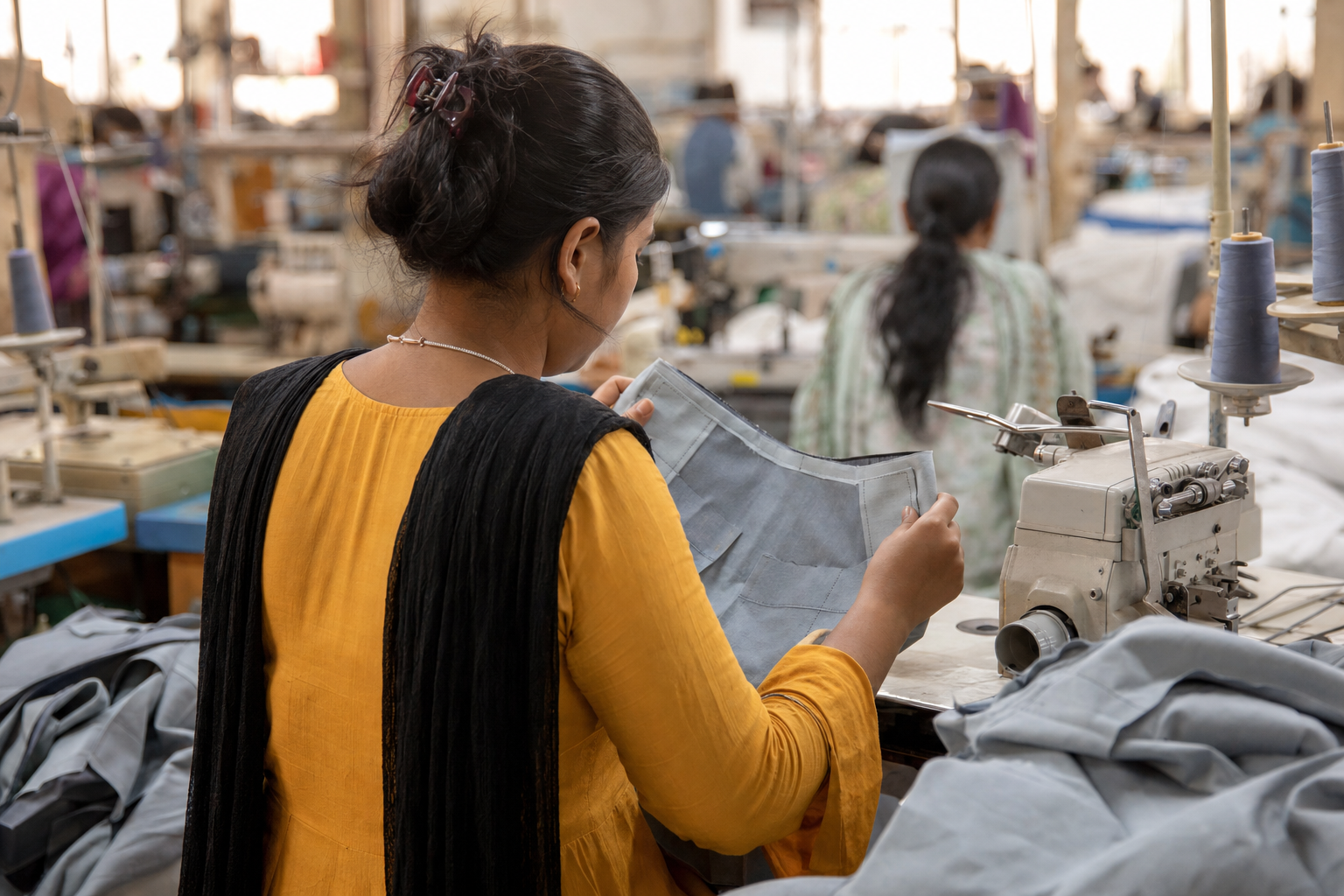
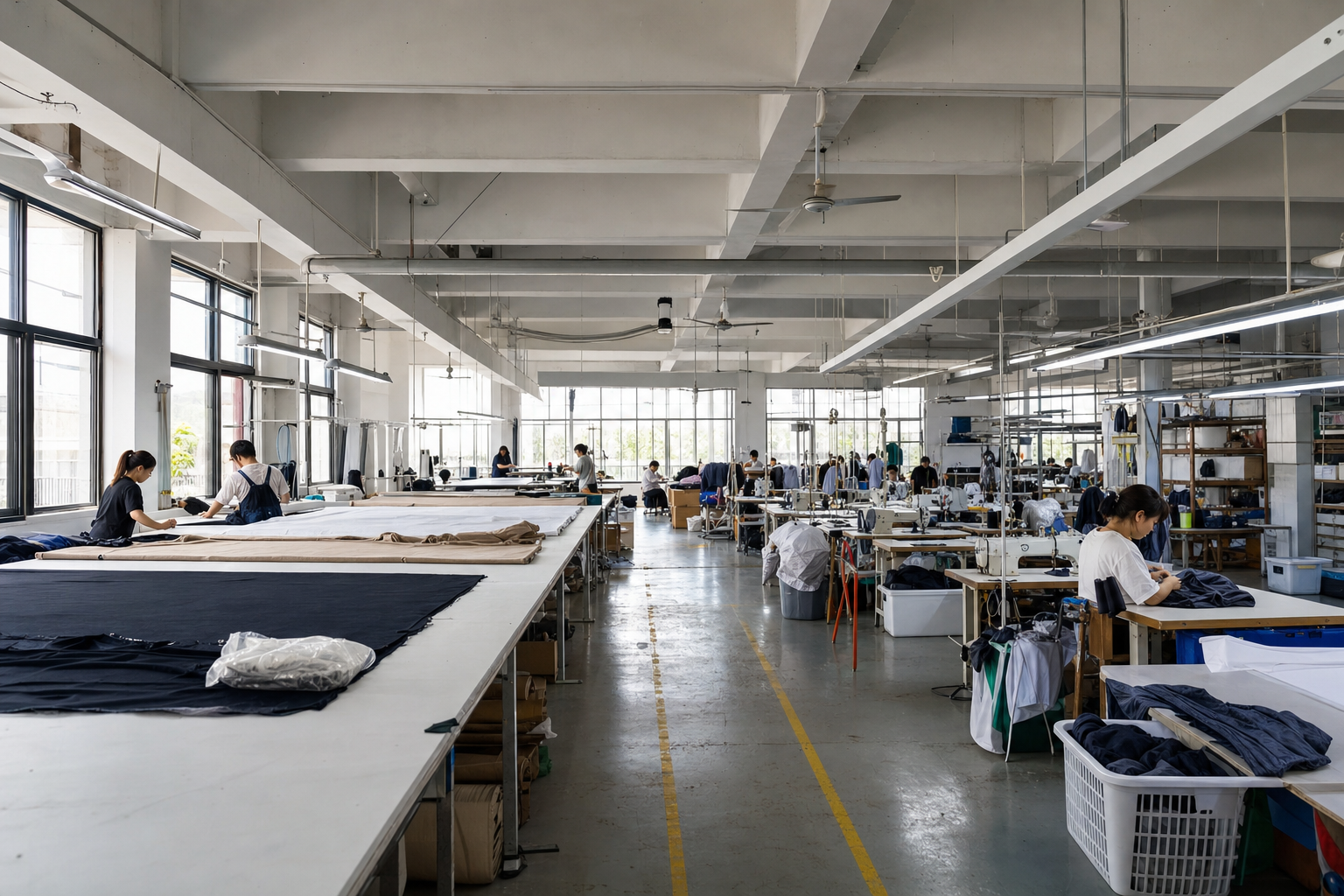
The choice is between two operating models. In-house production means you own or lease a cutting and sewing facility, employ or directly contract the operators, buy the machines, and carry the fixed cost of that capacity whether orders fill it or not. Sourced cut and sew means you contract production to external factories, domestic or offshore, who own the capacity and quote you per unit against a tech pack, with minimums and lead times set by them.
There is a hybrid that most brands land on eventually: in-house sampling and small-run production for cores and reorders, sourced cut and sew for seasonal breadth. We will get to when that hybrid is the right answer and when it is a way of avoiding the real decision.
Underneath this decision sits a reconciliation problem every apparel operator knows: what production says it made, what the warehouse says it received, and what the order book says is owed rarely agree. That problem gets worse, not better, when you split production across an in-house line and several external factories without a system that treats them the same way. The decision below is not just about where the sewing happens. It is about what your production data looks like on Monday morning.
The one criterion that usually decides it
Assortment shape. If your range is tight, built around a core carry-over program that reorders several times a year at predictable volumes, in-house production has the steady run rate it needs. The fixed cost of a small line gets absorbed by repeat work instead of sitting idle, and the quality tolerance on a core program (where customers notice a stitch change) is easier to hold with operators you see every day.
If your range is broad, spread across several drops a year with significant style turnover each season, sourced cut and sew is almost always the right answer. You cannot staff an in-house line against an assortment that changes that much. You would either sit idle between drops or run perpetually behind.
The brands that mix this up pay for it in BP2, where production execution drifts from the plan. An in-house line running a broad seasonal range misses dates because the operators are always learning new constructions. A sourced model running a tight core program eats lead time on reorders because the factory deprioritizes a small repeat against a larger new buyer.
What else matters, in order
After assortment shape, the criteria that actually move the decision are minimum order quantities, cash cycle, construction complexity, and maker dependence. The watch-outs on factory communication, QC, and shipment reconciliation live in the production drift diagnostic under BP2 and apply to both models.
Minimum order quantities
External cut and sew factories set minimums per style and per colorway, and offshore minimums usually sit above domestic ones. If your buy plan calls for a short run of an extended size in an off-season color, below what the factory will cut, you either overbuy and mark down, split the minimum across colorways, or skip the SKU. In-house production effectively has a minimum of one. For brands with long-tail sizing (extended size runs, petite and tall, plus) or deep colorway programs, the MOQ math alone can justify a small in-house line.
Cash cycle
Sourced cut and sew usually asks for a deposit at PO and the balance before shipment, on a lead time from approved sample that the factory’s calendar sets, not yours. That is cash out well before the goods sell. In-house production spreads cash differently: capex and fixed labor up front, shorter work-in-process cycle, faster turn from fabric receipt to finished goods. If you are tight on working capital and your lender is watching the inventory line, in-house can look worse on the balance sheet (more fixed assets, longer depreciation) but better on the cash conversion cycle. If you are capital-constrained and growing, sourced is usually easier to finance because inventory at a contract factory is still inventory on your books.
Construction complexity
Tailored outerwear, structured dresses, and anything with piecework that rewards operator skill (hand-finishing, bias cuts, pattern matching) holds quality better in-house where you can train and retain operators. Basic jersey, woven tops, and simple cut-and-sew knit programs are commodity work that external factories do as well or better than a small in-house line.
Maker dependence
Some brands sell the story of who made the garment. Made in LA, made in New York, made by a specific atelier. If that story is load-bearing for your price point or your retailer relationships, in-house (or a named domestic partner you treat as in-house) is not really optional. The decision is already made; the question is how to run it without BP2 drift.
A side-by-side at the decision point
Take a hypothetical brand running wholesale plus DTC on a 3PL, and assume it sells into somewhere between 80 and 200 specialty stockists. Those inputs are illustrative, not a real customer. The comparison below is qualitative on purpose: it describes how each model behaves for an operation shaped like that one, not quoted factory terms, which vary by partner, category, and country.
| Attribute | In-house production | Sourced cut and sew |
|---|---|---|
| Minimum per style/color | Very low; a single unit is possible | Set by the factory; offshore usually higher than domestic |
| Lead time from approved sample | Shorter; you own the schedule | Longer; the factory’s calendar sets it |
| Reorder lead time on a core | Short; slots into the next run | Long; small repeats wait behind new buys |
| Fixed cost absorption risk | High in slow seasons | Low; you pay per unit |
| Capex and setup | Machines, lease, patternmaker, line lead | Minimal; sample costs and PO deposits |
| Quality tolerance on complex construction | Tighter; direct supervision | Depends on factory relationship and QC cadence |
| Cash profile | Capex up front, shorter WIP cycle | Lower capex, longer deposit-to-sellable cycle |
| Fit for seasonal breadth (broad range, several drops) | Poor; line churn breaks throughput | Good; factories are built for this |
| Fit for core carry-over program | Good; reorder cadence absorbs fixed cost | Poor; small repeats get deprioritized |
| Where it breaks under BP2 | Line schedule vs delivery plan drifts when seasonal styles get added mid-run | PO status in the factory’s system drifts from your production calendar; chasing WIP updates by email |
Notice that the failure modes are different, not symmetric. In-house breaks when you add newness to a line that was designed for repetition. Sourced breaks when visibility into the factory’s actual progress lags your internal plan. Both are versions of the same underlying issue: production execution drifting from what your team is planning against.
Where the hybrid actually works
The hybrid model (in-house sampling and core production, sourced seasonal) is the right answer when you have a clearly identifiable core program that carries a meaningful share of annual units, and a seasonal program that is genuinely separate in construction and buy cadence. It is not the right answer when the core program is a handful of styles pulled out of the main line because they happened to reorder well last year. In that case you end up with an in-house line that is too small to run efficiently and a seasonal buy that is too fragmented to get good factory pricing.
The operating problem with the hybrid, and the reason most brands underestimate it, is that you now have two production workflows running against one order book. A connected production management module has to handle both: WIP against the in-house schedule, PO status against external factories, both feeding the same inventory truth and the same allocation logic. If those two workflows live in different spreadsheets or different tools, BP2 drift happens on both sides and nobody sees it until a ship window closes.
A brand running wholesale plus DTC plus a 3PL on disconnected tools already has someone moving data between systems by hand. Split production adds to that load rather than sitting outside it: chasing WIP, updating ship dates, rebuilding the allocation list when a factory slips. That person is the production coordinator, buyer, or account manager you did not get. The next stockists you want to onboard are waiting on headcount you are already spending on plumbing.
The POV
The industry conversation treats in-house vs sourced as a margin and control debate. It is not. At this stage, margin differences between the two models are usually small and can go either way depending on utilization and factory pricing. The real decision is whether your assortment shape can support a fixed-cost line and whether your production and sourcing operating model is set up to treat in-house and external capacity as the same kind of thing: a PO with a delivery date, a WIP status, a receipt against expected, and a cost that lands in inventory valuation when goods are received.
Generic ERPs underbuild this part of apparel. They can hold a PO and a receipt, but they do not model a cut ticket, a bundle, a size and color breakdown, or a ship window against a retailer’s cancel date. Horizontal commerce platforms do not pretend to model production at all. The gap is the whole reason the 6 Breakpoints framework puts BP2 where it does: production drift is not a symptom of bad factories or lazy operators. It is a symptom of production data living somewhere other than where orders and inventory live.
Choose A when, choose B when
Choose in-house production when your assortment is built around a tight core carry-over program with predictable reorder cadence, your construction is complex enough that operator skill matters, your brand story is tied to a specific place or maker, or your size and colorway depth puts you below external MOQs on much of your buy. Choose sourced cut and sew when your range is broad and spread across multiple drops a year, your seasonal turnover is high, your working capital is tight enough that fixed labor is a risk, or your construction is commodity knits and wovens that external factories do well. Choose the hybrid only when the core and seasonal programs are genuinely separate buy cycles, not when the core is a few accidental repeat styles. Whichever you pick, the structural work is the same: production has to live in the same system as orders, inventory, and receipts, or BP2 drift will find you.
Where is your operation on the 6 Breakpoints curve?
The assessment scores your apparel operation across all six breakpoints (product data, production, inventory truth, order flow, warehouse execution, reporting) and identifies which one is hurting you most.
Frequently asked questions
Where this fits in the Uphance platform
Venkat is the Founder and CEO of Uphance and the author of the 6 Breakpoints of Apparel Operations framework. He writes about operational clarity for apparel brands as complexity grows across channels, warehouses, partners, and teams. His work focuses on why disconnected operations, not growth itself, create the chaos most mid-market brands feel between $5M and $100M in revenue, and on the operating-model patterns that decide whether scaling a brand strengthens execution or fractures it. He argues that the status quo is the real competitor in apparel software, and that the right move is fewer systems with deeper connection, not more dashboards.
Isabelle writes about onboarding, workflow enablement, and how apparel teams build confidence in connected operations during rollout and beyond. As a Customer Success and Onboarding Manager at Uphance, she partners with apparel brands through their first three weeks on the platform: configuration, training, and the tactical playbooks that get day-to-day workflows running. Her articles focus on how-to guidance for product, inventory, and order operations, written for the people who actually run the workflows. She covers when to use which configuration, how to write the training docs, and what the first thirty days inside a connected platform look like in practice.