
Bridal made-to-order operations: quoting, cutting, and delivery windows
What do bridal made to order apparel operations actually look like on a Tuesday?
It is 10:40 AM at a bridal atelier in the Garment District. The owner is on the phone with a bride in Denver who wants to add a detachable overskirt to an order that was quoted six weeks ago. The production manager is standing at the cutting table with a marker printout for a different gown, waiting to hear whether the customer approved the silk substitution because the original mill went short. A third style, promised for a June 14 wedding, has not yet left the sample room, and the fabric for it cleared customs yesterday. Somewhere in a shared inbox is the deposit receipt that proves the Denver bride paid for the beading upgrade. Nobody can find it.
That is bridal made to order apparel operations in one frame. Every gown is a project. Every project has a bride, a date, a fabric that may or may not exist, a set of measurements that may or may not be final, a price that keeps moving, and a delivery window with zero tolerance on the back end. The operational question is not “do we have inventory” but “do we have a plan that survives contact with the calendar.”
How is made to order bridal different from stock bridal or MTM ready-to-wear?
A precise definition matters here because the category gets flattened in most software conversations. Bridal made to order apparel operations means: a garment is cut and constructed against a specific customer order, from a base pattern that is graded or altered to that customer’s measurements, using materials that are either sourced per order or drawn from a limited atelier stock, delivered by a fixed date tied to an event. It sits between couture (fully bespoke, pattern drafted from scratch) and made to measure ready-to-wear (a stock style adjusted for fit).
The operational implication is that every order is simultaneously a sales order, a production order, a purchase order for materials, and a project with milestones. Standard apparel software assumes those are four different objects. In bridal, they collapse into one, and if the system cannot hold them as one, the atelier holds them together with paper, WhatsApp, and the owner’s memory.
Looking at where apparel brands in adjacent categories keep buckling as they cross $10M, the pattern in bridal is sharper and earlier. A bridal house doing $6M can already be drowning, because the unit of chaos is the order, not the SKU, and order volume scales with revenue directly. There is no reorder pool absorbing complexity for you.
Why does the quote itself become an operational document?
In stock apparel, a quote is a sales artifact. In bridal made to order, the quote is the first draft of the production spec. It names the base style, the customer, the size range or measurement set, the fabric selection, the trim and beading options, the customization charges, the deposit terms, the estimated ship date, and any regional considerations for delivery or duties. Every one of those fields flows downstream into cutting, sourcing, finance, and shipping.
When the quote lives in a Word template that gets emailed as a PDF, none of that data structure survives. The production manager reads the PDF and retypes the spec onto a paper cut ticket. The bookkeeper reads the PDF and enters a deposit into QuickBooks with a memo field. The atelier orders 4.2 yards of silk based on the pattern maker’s estimate, not the quote. Three weeks later, the bride asks to change the neckline, and there is no single record to update. There are five records, in five places, and four of them will not be updated.
This is what customers are actually buying when they buy a connected production system. Not features. They are buying the ability for a quote change on Tuesday to reach the cutting room and the accountant on Tuesday, without anyone retyping anything. That is the entire product argument in one sentence.
Where does bridal production drift actually start?
Breakpoint 2 in the 6 Breakpoints framework is production and supply execution drifting from the plan. In stock apparel that shows up as a PO landing three weeks late and blowing a drop. In bridal made to order, it shows up earlier and more personally. It shows up as a cut date that slips because the fabric confirmation email got buried, and now the gown that needed six weeks of hand beading has five.
The drift compounds through the workflow. A one-week fabric delay pushes the cut. The cut push shortens the beading window. The beading team runs the piece hot and misses a detail. The detail gets caught in fitting, which pushes final press. Final press pushes shipping. Shipping now needs to be air freight instead of ground, and the atelier eats the difference because the delivery date is a wedding date. One week of upstream slippage becomes $400 of unrecovered freight and a fitting that happens on the wedding morning instead of two days before.
A production drift diagnostic built for stock apparel tracks PO adherence, cut-to-ship lead time, and vendor on-time delivery. In bridal, the same diagnostic applies but the unit is the order, not the style. The question is: for orders shipped in the last 90 days, what percentage hit each internal milestone (fabric confirmed, cut, first fit, second fit, final press, shipped) on the date the calendar said they would? Most bridal houses have never measured this because they have never held the milestones in one system.
How should the critical path calendar work for a bridal order?
Every bridal order has a fixed downstream date (the wedding, or the required-by date the bride specifies, usually two to three weeks before the wedding to allow for final alterations at the bride’s local seamstress). Back-schedule from that date. A typical made to order bridal gown wants: 8 to 14 days shipping buffer including customs if international, 5 to 10 days final press and QC, 10 to 21 days finishing and hand work, 3 to 7 days sewing, 1 to 2 days cutting, 5 to 10 days material lead time after order confirmation, 2 to 5 days quote confirmation and deposit clearance. That is a 34 to 69 day critical path before any customization is added.
The operational discipline is that every one of those milestones is a date, and every date is visible to the owner, the production manager, and the atelier lead in the same view. When a milestone slips, the downstream dates recompute automatically and the delivery risk gets flagged before the bride is affected. The point is not the software. The point is that a bridal house running 40 to 80 active orders at any given time cannot hold 40 to 80 critical paths in a spreadsheet without something falling through.
Run the critical path review daily during peak bridal season (typically January through May for spring and summer weddings), and weekly the rest of the year. Daily is not too often. A one-day slippage caught on Tuesday can be recovered. The same slippage caught on Friday cannot.
Why do custom charges and upgrades leak margin so badly?
Here is where the bridal P&L usually bleeds silently. The base gown is quoted at $4,800. During the process the bride adds a custom bustier construction ($350), longer train ($200), hand-beaded shoulder detail ($600), and a rush charge because she moved the wedding date up by two weeks ($400). That is $1,550 of add-ons. In a well-run atelier, all four are captured, invoiced, and produced. In a typical atelier, two of them are captured on the invoice, one is remembered by the pattern maker and produced without being billed, and one is billed but never produced because the request came in on a call that was never written down.
The leak is bidirectional and it is not small. On a book of business of 300 orders per year with an average of $1,000 in custom charges per order, capturing 85 percent of them instead of 100 percent is $45,000 of margin left on the table. Producing 5 percent of unbilled requests is another $15,000. This is real money at an atelier doing $6M to $12M.
The structural point: bridal should not run custom charges through the salesperson’s memory. Every change request against an active order needs to hit the order record, trigger a change confirmation to the bride, adjust the deposit or final balance, and flow into the production spec. If any of those four steps is manual, the leak persists.
What does the cutting room actually need from the system?
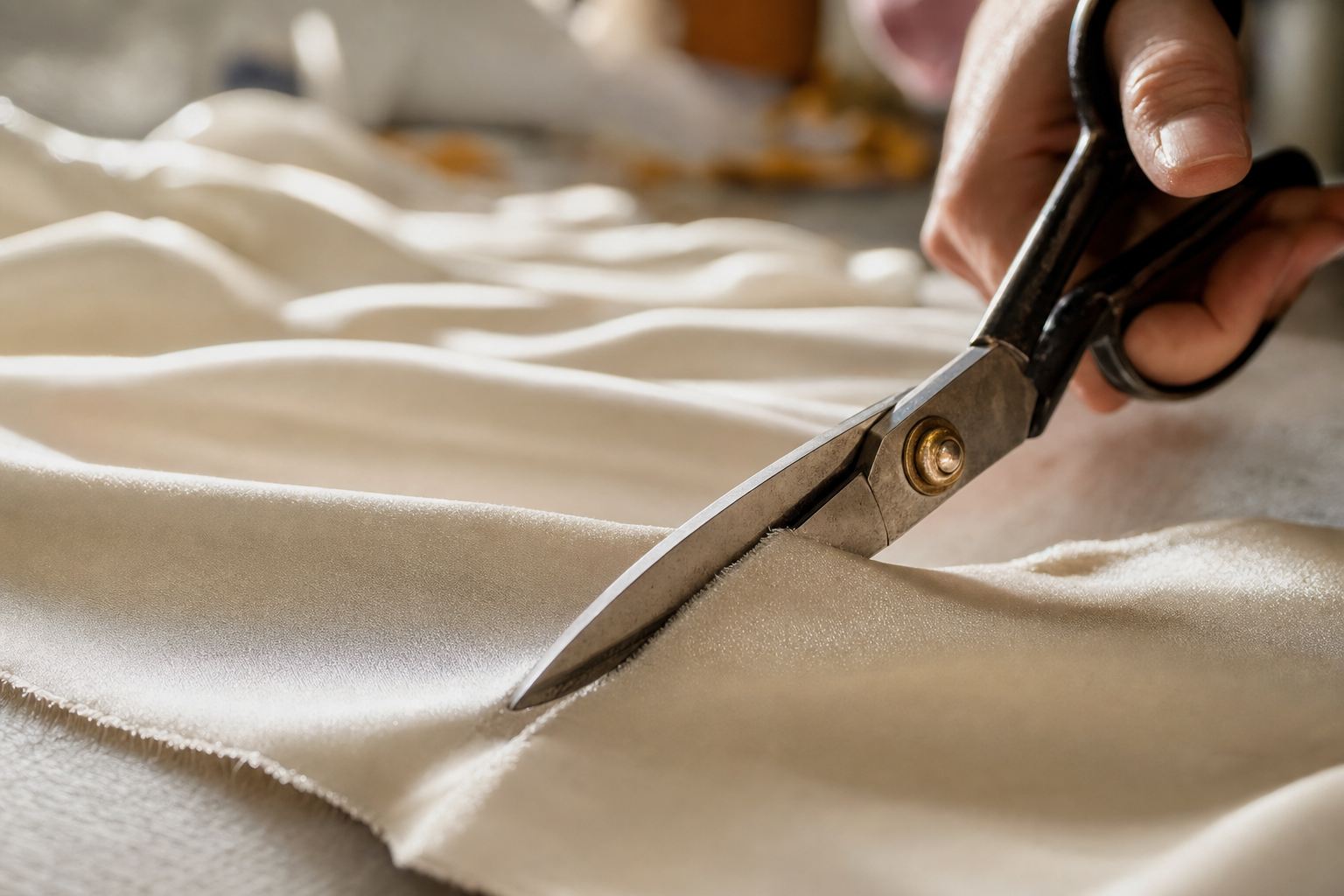
Cutting is the pivot point where a bridal order becomes physically committed. Before the cut, changes cost email. After the cut, changes cost fabric. The cutting room needs three things from the operational system, in this order.
First, the confirmed spec at the moment of cutting, not the spec as it existed when the quote was written. If the bride upgraded the fabric on day 12 and the cut happens on day 18, the cutting room needs to be pulling the day-18 spec automatically. Second, the confirmed measurement set for that order, tied to the pattern grade or alteration notes. Third, the cut ticket itself as a printable or scannable artifact that follows the bundle through sewing and finishing.
Atelier owners often push back that their cutting team “just knows” the current spec because they were in the fitting. That works at 15 active orders. At 60 active orders across three cutters, it does not, and the misses are unrecoverable because you cannot un-cut silk.
When should the delivery window be committed, and to whom?
Here is a clear point of view: the delivery window quoted to the bride at deposit should be a range (for example, 4 to 6 weeks before the wedding date), and the specific ship date should be committed internally on the critical path but never quoted to the bride until final press is complete. This protects the atelier from the trap of a bride booking a fitting three days after a promised delivery date, then treating the promised date as immovable when production is running two days late.
Internally, the ship date is a hard commitment against which the production team is measured. Externally, the bride knows the window and gets a firm date once the gown is essentially finished. This is how connected production and order flow actually protects both margin and reputation. The system holds two dates, the internal target and the external commitment, and neither one is a lie.
The same discipline applies to accessories and to the second-piece problem (reception dress, bridesmaid coordination) where the calendar has to align across multiple garments for the same event. If the reception dress ships two weeks after the ceremony gown because they are managed as separate orders with independent critical paths, someone is paying rush freight.
How does international delivery and duties compound the problem?
A bridal house shipping to a bride in London, Sydney, or Dubai is not just adding freight days. It is adding a customs brokerage step, a duties calculation that depends on the declared value (which includes all those custom charges), and in some destinations a VAT collection obligation that the atelier may or may not be registered for. If the declared value on the customs form does not match what the bride paid, the shipment gets held. If the shipment gets held for four days, the wedding gown that had a two-week delivery buffer now has ten days, and the bride’s local seamstress cannot get her fitting slot back.
Magnolia Pearl faced a version of this problem at scale on the DTC side, where the operational fix was pulling international duty handling into the same order and fulfillment flow rather than treating it as a shipping department afterthought. The bridal version is the same principle at lower volume and higher stakes. Every international bridal order needs the declared value, the HS code, the destination duty treatment, and the buffer days built into the critical path from the moment the order is confirmed, not the moment the gown is boxed.
Why do bridal ateliers stall between a POS and a generic ERP?
The tooling gap in bridal is real and it is the reason this category keeps buckling in the $5M to $15M zone. On one side are point-of-sale and CRM tools built for the salon experience, which handle appointments and deposits reasonably well but have no concept of a cut ticket or a critical path. On the other side are generic ERPs built for manufacturing, which handle work orders and bills of materials but have no concept of a bride, a fitting cycle, or a wedding date. Neither one holds the shape of the actual business.
What sits in the middle is what apparel operations actually need: a system where the quote, the customer, the production spec, the material commitment, the critical path, the deposit ledger, and the delivery window are one connected record. That is the category argument, and it applies to bridal made to order more sharply than to almost any other apparel segment, because the cost of disconnection is not a lost sale. It is a bride in tears three days before her wedding. That cost does not show up in the P&L but it shows up in every review the atelier receives for the next two years.
What changes when the operational spine gets connected?
The atelier owner who was on the phone with the Denver bride at 10:40 AM stops being the human integration layer between quote, cut, and ship. The change request lands on the order record, the cut ticket regenerates with the new spec, the deposit adjustment flows to finance, and the critical path recomputes to show whether the June 14 date is still safe. The production manager sees the change on the floor tablet, not by walking to the owner’s office. The bookkeeper sees the balance change in the same window they use for every other order.
None of that removes the craft. The hand beading still takes 21 days. The fitting still requires a human. The silk still shorts sometimes. What changes is that the atelier can hold 80 active orders without holding them all in the owner’s head, and the delivery window stops being a hope. It becomes a date the system defends every morning before anyone drinks coffee.
The bridal calendar rewards operational rigor more than any other apparel segment
Most apparel categories can absorb a week of drift. A wholesale drop that ships on Friday instead of Monday costs a chargeback and a difficult phone call. A bridal gown that ships on Friday instead of Monday, when Monday was the last safe date before a Saturday wedding, costs a customer relationship and a story that travels. The asymmetry is total.
That asymmetry is the reason bridal ateliers who invest in operational discipline early tend to compound faster than peers who wait. Not because the operations become a competitive weapon in marketing, but because the owner’s Tuesday morning stops being spent finding a deposit receipt in a shared inbox, and starts being spent on the next collection, the next store, the next hire. That is what the fix actually buys.
FAQs
Where is your operation on the 6 Breakpoints curve?
The assessment scores your apparel operation across all six breakpoints (product data, production, inventory truth, order flow, warehouse execution, reporting) and identifies which one is hurting you most.
Frequently asked questions
Venkat is the Founder and CEO of Uphance and the author of the 6 Breakpoints of Apparel Operations framework. He writes about operational clarity for apparel brands as complexity grows across channels, warehouses, partners, and teams. His work focuses on why disconnected operations, not growth itself, create the chaos most mid-market brands feel between $5M and $100M in revenue, and on the operating-model patterns that decide whether scaling a brand strengthens execution or fractures it. He argues that the status quo is the real competitor in apparel software, and that the right move is fewer systems with deeper connection, not more dashboards.
Ruchit writes about product strategy for apparel operations, covering how mid-market fashion brands use connected workflows to manage product development, inventory, orders, warehouse execution, and reporting. As Head of Product at Uphance, he shapes the roadmap that ties PLM, PIM, BOM management, allocation, fulfillment, and warehouse operations into one system. His articles dig into apparel-specific operational mechanics: tech packs, spec sheets, putaway, pick-pack, landed cost, and the data plumbing that makes inventory truth possible across multiple channels and locations. He focuses on the workflow-level questions that separate generic ERPs from systems built for how apparel brands actually run.