How to Decide Between a 3PL and an In-House Warehouse for an Apparel Brand

Tuesday morning, and the ops lead at a $12M apparel brand is on her third Slack thread before 10am. The 3PL says it shipped 412 DTC orders yesterday. Shopify says 438 were marked fulfilled. The wholesale team is asking why a Nordstrom PO is showing allocated stock that the 3PL claims it does not physically have. Somewhere in the middle, two SKUs from last week’s drop are sitting in a returns bin that nobody has processed in nine days. She is not deciding whether the 3PL is good. She is deciding whether the architecture above the 3PL is wrong.
How should an apparel brand decide between a 3PL and an in-house warehouse?
The 3pl vs in house warehouse apparel decision is rarely about pick rates or square footage. It is about channel mix, drop cadence, retailer compliance exposure, and whether the brand can carry warehouse labor as a fixed cost through the seasonal trough. Most $5M to $100M apparel brands ask the question at the wrong altitude. They benchmark cost per order against a 3PL quote and conclude the 3PL wins or loses on margin. That math ignores the operational cost of running wholesale EDI, the labor cost of returns processing during drop weeks, and the inventory truth problem that sits above whichever warehouse you pick.
A precise definition. The 3pl vs in house warehouse apparel choice is an outsourcing decision for the physical execution layer of Breakpoint 5 in the 6 Breakpoints framework, the point at which warehouse execution drifts from the order system. The decision should be made after you have decided how product data, production, inventory, orders, and reporting will run. Pick the system of record first. Pick the warehouse second. Brands that reverse this order spend the next two years rebuilding integrations.
What does each option actually cover?
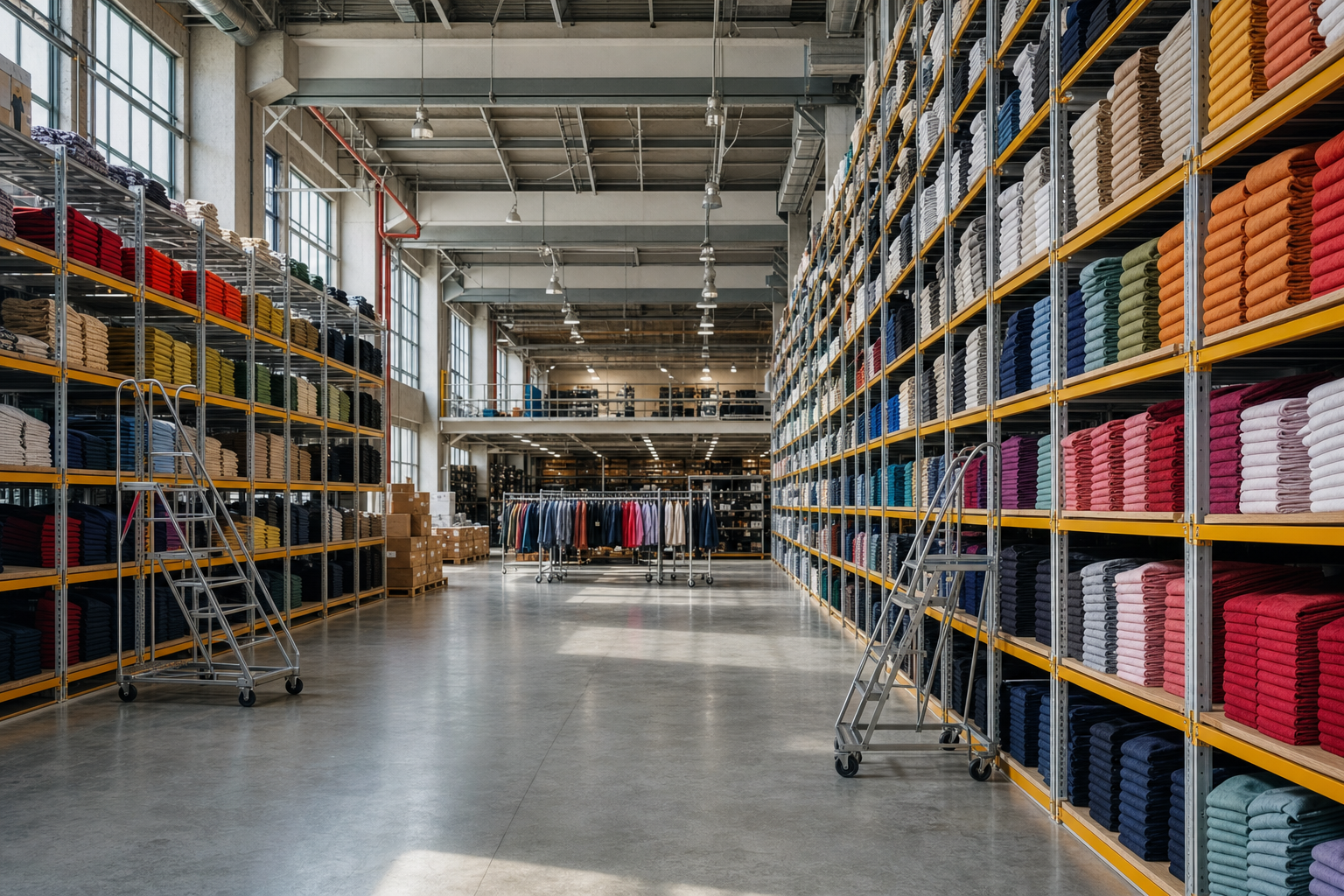
An in-house warehouse means the brand leases space, hires pickers and packers, runs its own WMS or barcode workflow, and owns the labor schedule. The brand controls cutoffs, returns triage, custom packaging, drop launches, and how quickly a sample request gets out the door. The brand also owns the lease, the workers’ comp, the forklift maintenance, the seasonal hiring problem, and the question of what the warehouse staff does during the slow weeks between collections.
A 3PL is a third-party logistics provider that handles inbound receipt, putaway, pick and pack, parcel handoff, and usually returns. Apparel-capable 3PLs also handle GS1-128 carton labels, EDI 856 ASNs to retailers, routing guide compliance, and value-added services like ticketing and polybagging. Most generic 3PLs do not. That distinction matters more than the cost per pick. A 3PL that cannot send a compliant ASN to Saks within the routing window will generate chargebacks that wipe out any savings on the pick rate.
Which channels are you actually running?
Sitting in fit calls with prospects week after week has taught me that channel mix predicts the right answer more reliably than revenue does. A $15M brand that is 90 percent DTC with light wholesale has very different warehouse requirements than a $15M brand running EDI to fifteen majors, a B2B portal for 200 boutiques, a Shopify store, and an Amazon Seller Central account.
The DTC-heavy brand can usually use a single 3PL with strong parcel rates and decent returns handling. The wholesale-heavy brand often needs either an in-house warehouse for the wholesale lane or a specialized apparel 3PL that prices EDI compliance as a line item rather than an afterthought. The mixed brand frequently splits, in-house or a boutique 3PL for wholesale, a parcel-optimized 3PL for DTC. Splitting is operationally heavier but often cheaper than forcing one warehouse to do both badly.
This is also why Shopify’s native flow is the wrong vehicle for wholesale. The moment you have committed wholesale pools, retailer-specific pack configurations, and ASN obligations, the DTC stack stops being the right system of truth. The warehouse decision is downstream of that.
How fast is your drop cadence?
Drop cadence is the variable most brands underweight in the warehouse conversation. A brand releasing two seasonal collections per year can run almost any 3PL competently. A brand running weekly drops with same-day cutoffs is asking the 3PL to operate on a launch rhythm, which most of them are not staffed for.
Magnolia Pearl is a useful reference here. The collection cycle, the same-day fulfillment expectations from a loyal DTC base, and the international duty handling create a labor and customs profile that a generic 3PL contract will not absorb. Brands with that profile often keep fulfillment closer to in-house, or sign with a 3PL that prices the drop weeks separately from the steady state. If you sign a flat rate and then push three drops through the warehouse in six weeks, the 3PL will either renegotiate or quietly let your service level slip.
What is the true reconciliation cost?
This is where the back-of-envelope math gets uncomfortable. For a $15M brand running wholesale plus DTC plus 3PL, we typically see someone lose six to nine hours a week squaring stock counts between Shopify, the 3PL portal, and the wholesale order book. Oversell rates run two to three percent at peak. One FTE has, in practice, become a data plumber rather than an operator.
That cost does not disappear when you switch warehouses. It disappears when you fix the system of record above the warehouse. Brands that move from one 3PL to another expecting the reconciliation problem to solve itself are disappointed within a quarter. Brands that put a unified apparel operations platform above the warehouse can then choose the warehouse on its physical merits, because inventory truth lives in the system, not in the warehouse’s WMS.
When a buyer walks me through a warehouse shortlist, the question I ask after the rate card is, where does the committed wholesale pool live today, and the answer is almost always a spreadsheet. That spreadsheet is the real reason the warehouse keeps shipping the wrong unit to the wrong channel.
What does retailer compliance actually require?
If the brand sells to majors, the warehouse has to handle GS1-128 carton labels, EDI 856 ASNs within the retailer’s window (usually 1 to 2 hours after pick), routing guide carrier selection, and packing rules that vary by retailer. Nordstrom is not Saks is not Bloomingdale’s. The chargeback math is unforgiving.
If your retailer chargebacks exceed 1 percent of wholesale revenue, the fault line is the EDI integration, not the warehouse. Brands frequently fire a 3PL over chargebacks and then discover the next 3PL produces the same chargeback rate, because the order data leaving the system of record was already wrong. Lufema is the pattern to study here, multi-entity wholesale, a B2B portal, and a multi-brand catalog all need the same compliance discipline at the warehouse layer, and the only way that scales is if the order data leaving the system is clean before it hits the warehouse.
The POV: pick a warehouse, in-house or 3PL, that can prove it has shipped EDI-compliant ASNs for at least three of your target retailers in the last 90 days. Ask for the chargeback rate. If they will not share it, you have your answer.
When does in-house actually win?
In-house wins in four specific situations. First, when drop cadence is high enough that the warehouse needs to operate as a launch team rather than a steady-state pick line. Second, when the brand has unusual value-added requirements, hand-finishing, signature packaging, monogramming, that a 3PL would price at a premium that erases the labor arbitrage. Third, when wholesale volume is high enough that an in-house wholesale warehouse can run more cleanly than a 3PL juggling fifty other clients’ routing guides. Fourth, when returns volume is high and a returned SKU has to be sellable again within days, because it will be resold inside the same season.
Days, not weeks, is the bar for getting a return back into inventory. Most 3PLs treat returns as a low-priority queue. If you are running a brand where a returned unit is a sellable unit two days later, in-house gives you control that no 3PL contract clause will replicate.
When does the 3PL actually win?
The 3PL wins when the brand wants to convert fixed warehouse cost into variable cost, when volume is too seasonal to justify year-round labor, when geographic distribution matters (a coastal 3PL saves real parcel cost), and when the brand does not want to be in the business of hiring and managing warehouse labor.
The 3PL also wins for most brands under $10M in revenue, because the in-house fixed cost cannot amortize. Above $30M, in-house starts to make math sense for the wholesale lane specifically. Between $10M and $30M, the answer is almost always a 3PL with the right capability profile, paired with a system of record that holds inventory truth above it.
How do you evaluate a 3PL for apparel?
The evaluation questions that matter, in order. Can you produce GS1-128 labels and EDI 856 ASNs for my target retailers, and what is your chargeback rate. How do you handle returns, what is the SLA from receipt to inventory adjustment, and how is that adjustment communicated to my system of record. How do you price drop weeks and peak season, and is there a surge clause. How do you handle international duties and DDP shipments if I sell cross-border. What is your inventory accuracy rate on cycle counts, measured how, audited by whom.
A 3PL that answers four of those five well is a viable partner. A 3PL that wants to talk about cost per pick before any of those is not selling to apparel brands, regardless of what their website says.
What architecture sits above either choice?
The warehouse, in-house or 3PL, is the execution layer. Above it, the brand needs a system that holds product data once, holds inventory truth across DTC and wholesale and B2B portal channels, and pushes clean orders into the warehouse with the right pack configuration, ship window, and compliance flag. That is the architectural fix to Breakpoint 5. Without it, the warehouse choice is cosmetic, the same reconciliation problem will reappear under whichever logo is on the building.
The brands that solve this run product development, product data, production, inventory, orders, warehouse execution, payments, and reporting in one connected system, and then the warehouse becomes a contract decision rather than an existential one.
The warehouse is the second question
The ops lead from the opening scene does not have a 3PL problem. She has an architecture problem that the 3PL surfaces every Tuesday morning. Changing 3PLs without changing the system above it will buy her six months of relief and then the same threads will reappear.
The sequence is, fix the system of record, define the channel-aware inventory model, build the clean order flow to the warehouse, then evaluate the warehouse on physical execution, parcel rates, compliance capability, and surge pricing. Brands that follow that order get to choose the warehouse on its merits. Brands that reverse it spend the next renewal cycle solving the same problem under a different vendor’s name.
The 3pl vs in-house question is real, but it is the second question, not the first.
Where is your operation on the 6 Breakpoints curve?
The assessment scores your apparel operation across all six breakpoints (product data, production, inventory truth, order flow, warehouse execution, reporting) and identifies which one is hurting you most.
Frequently asked questions
Where this fits in the Uphance platform
Shubham writes about evaluating ERP fit, assessing operational complexity, and how apparel brands can tell whether their current systems are helping or holding them back. As a Solutions Consultant at Uphance, he runs discovery conversations and fit assessments for apparel brands moving off patchwork stacks of PLM, PIM, inventory, and B2B tools. His articles cover ERP selection, vendor RFPs, comparison frameworks, and the operational signals that tell a brand it has outgrown spreadsheets and point solutions. He focuses on how mid-market apparel teams evaluate connected platforms against the cost of staying with what they have.
Venkat is the Founder and CEO of Uphance and the author of the 6 Breakpoints of Apparel Operations framework. He writes about operational clarity for apparel brands as complexity grows across channels, warehouses, partners, and teams. His work focuses on why disconnected operations, not growth itself, create the chaos most mid-market brands feel between $5M and $100M in revenue, and on the operating-model patterns that decide whether scaling a brand strengthens execution or fractures it. He argues that the status quo is the real competitor in apparel software, and that the right move is fewer systems with deeper connection, not more dashboards.